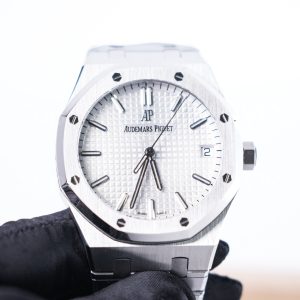
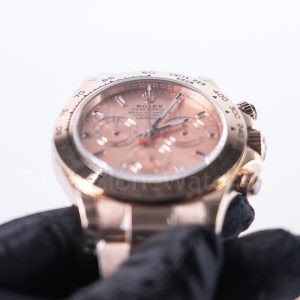
A static front photo can show whether a dial looks centered, but it cannot prove that a chronograph starts, stops, resets to zero or responds correctly at the pushers. That is the decisive weakness in many Clean vs VSF Daytona comparisons.
There is no responsible factory winner without an exact reference and evidence from the actual watch. Clean may enter the shortlist when exterior execution is the main priority, while a VSF option should be judged only when the requested Daytona reference is genuinely available and its dial, case and chronograph operation can be demonstrated to the same standard.
This page assumes the broader replica watches category is already understood. The task here is narrower: define the Daytona reference, inspect the visible construction, separate photo evidence from video evidence and reject any piece that cannot complete the functional demonstration.
Daytona Inspection Route
Define the Daytona Reference and Dial First
Do not begin with “Clean or VSF?” Begin with the reference family, dial and bracelet or strap configuration. A white Panda 126500LN-style watch, an earlier 116500LN-style watch, a black-dial configuration, a 126518LN-style Oysterflex direction and a 126529LN Le Mans-style dial do not present the same inspection problem.
The reference controls the expected dial architecture, bezel treatment, case-side appearance and bracelet or strap connection. A factory comparison becomes unreliable when one seller is showing a standard Panda configuration and another is showing a special dial or precious-metal-style configuration. Those are different products, not evidence that one factory is better.
Use the official Cosmograph Daytona reference only for original design terminology and layout context. For the available site range, open the Daytona collection, record the exact listing URL and ask for confirmation that the QC watch matches that reference, dial and bracelet or strap direction.

Subdial Spacing, Printing and Hand Alignment
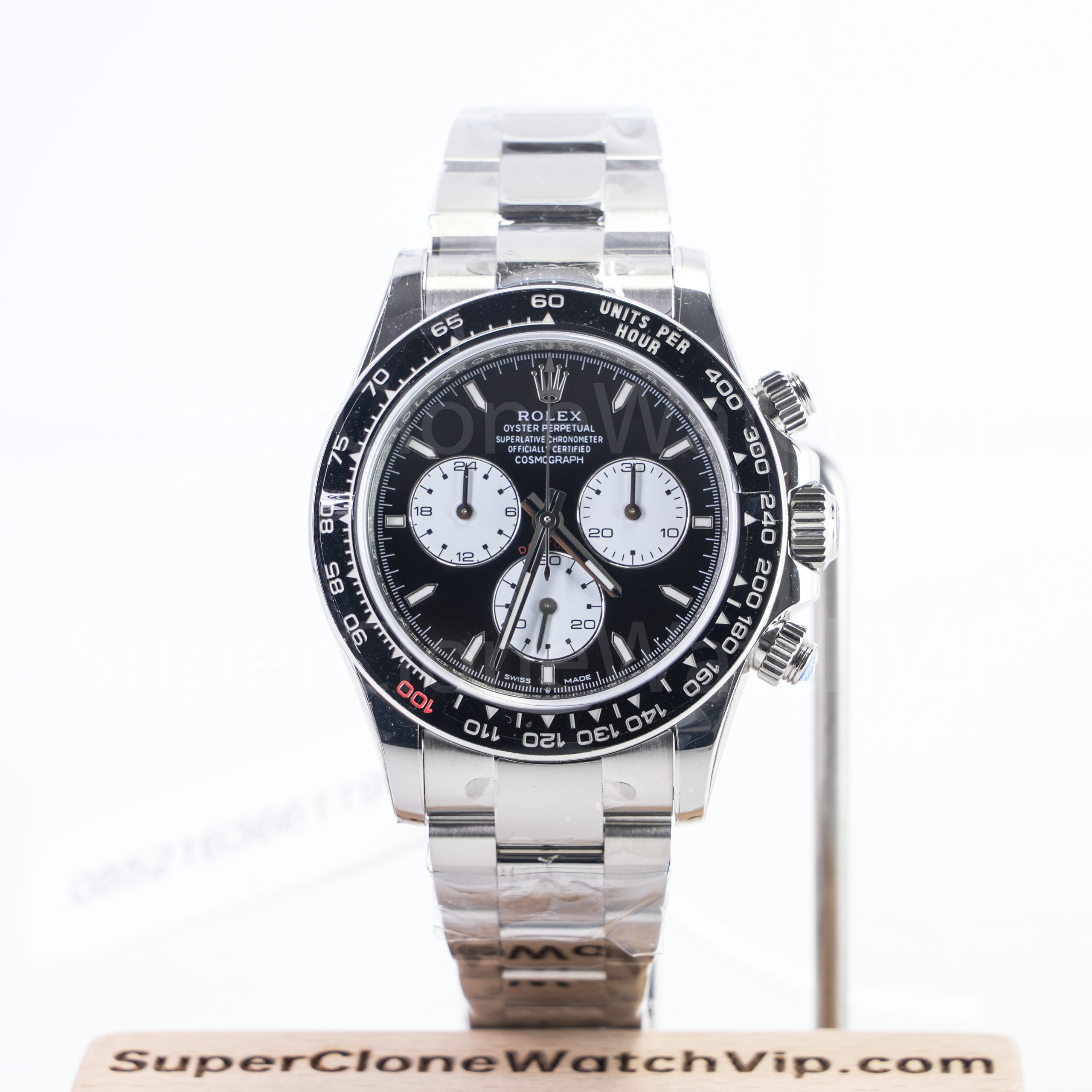
The dial is not one checkpoint. It is a set of relationships: the three counters must sit consistently within the selected reference layout; their rings should look even; printed numerals and hash marks should remain legible; applied markers should not lean; and the central chronograph hand should rest at 12 before the function test begins.
A Panda dial makes uneven spacing, thick printing and contamination easier to see because dark counters sit against a light field. A black dial can look cleaner in a bright catalog image while hiding dust, weak contrast or rough hand edges. Ask for one straight photograph at normal exposure and one close image with the hands moved away from important text. A photograph that covers the logo, counter numerals or six o’clock printing with the hands is incomplete evidence.
Reject immediately
A visibly displaced counter, a marker that clearly misses its minute track, a resting central hand that is plainly off zero, contamination under the crystal or printing that is unreadable in a focused macro image.
Request another angle
A possible misalignment that appears only in an off-axis photo, glare over one counter, a reflection that changes dial color or a hand position that blocks the feature under review.
Do not compare across references
Counter graphics, ring treatment and special-edition details can differ. Confirm the selected reference before deciding that a layout difference is a Clean or VSF weakness.
Ceramic Bezel Numerals and Case Profile
The bezel should be inspected in two different ways. A straight image checks the relationship between the 12 o’clock bezel position and the dial centre. An angled image checks numeral fill, surface reflections, outer edge finishing and whether the insert appears evenly seated. One glossy front image cannot do both jobs.
Case shape needs a crown-side profile, an opposite-side profile and a view across the lugs. Look for balanced lug geometry, consistent polishing, a clean transition between brushed and polished areas and a pusher/crown assembly that sits coherently against the case. Do not infer case thickness from a front photograph, and do not compare two watches photographed with different lens distances as though they were scaled identically.
For a buyer whose first priority is exterior resemblance, Clean is a logical starting shortlist only when the exact reference is available. VSF should remain in the comparison only when its current Daytona piece can provide equally clear bezel and profile evidence. A reputation earned on another model is not a substitute for Daytona-specific side views.
Pushers, Crown and Chronograph Operation
The pusher side is where a visually convincing watch can fail the functional comparison. Static images can show pusher height, cap shape, spacing, alignment and visible gaps. They cannot show whether the screw-down collars operate cleanly, whether the start and stop actions respond consistently or whether the reset action returns the central hand and active counters to their correct resting positions.
Ask for a continuous clip rather than separate edited snippets. The operator should show the watch before activation, release the upper pusher, start the chronograph, allow enough time for visible movement, stop it, restart it if the function supports that sequence, then use the lower pusher to reset. The camera should remain close enough to see the central hand and counters, while the operator’s fingers should not cover the dial during reset.
Practical rejection rule: do not approve a Daytona when the seller provides polished exterior photos but avoids a single, continuous start-stop-reset demonstration. For this model, missing function evidence is not a minor gap; it removes the most important comparison point.
Bracelet, Clasp and End-Link Fit
An Oyster-bracelet Daytona and an Oysterflex-style configuration require different evidence. On a bracelet model, inspect both end links, the gap where the bracelet meets the case, link articulation, brushing, polished centre surfaces, clasp alignment and the inside of the clasp. On a strap model, inspect the connection at both case ends, the underside fit, visible curvature and the clasp or buckle from open and closed positions.
Photographs can reveal uneven gaps, obvious scratches, poor surface transitions and a clasp that sits visibly off centre. A short handling clip can show articulation and closure, but it still cannot fully prove edge comfort, tactile sharpness or long-term clasp wear. Those limitations belong in the decision rather than being hidden behind a factory label.
When two options look similar at the dial, bracelet or strap fit can break the tie. Compare the same configuration on both sides; a strong Clean bracelet sample should not be used to dismiss a VSF Oysterflex sample, or vice versa.
Movement, Reset-to-Zero and Video Evidence
A movement label in a listing is not enough to settle Clean vs VSF Daytona. The useful question is whether the actual watch completes the required operations and whether the evidence matches the selected reference. Ask what movement or movement-style version is being offered, but approve the watch on demonstrated behaviour rather than a name alone.
Reset-to-zero should be recorded from a steady front view. Before starting, the central chronograph hand and relevant counters should be shown at rest. After the chronograph has run and stopped, the lower pusher should be used once, on camera. Watch for the central hand returning to its zero marker and for the recording counters returning to their resting points without an obvious second correction or a cut in the clip.
The evidence tool below prevents three common mistakes: expecting a photograph to prove motion, treating video as proof of internal origin and assuming remote QC can establish long-term reliability.
Static photos can check
- Reference, dial colour and visible layout.
- Subdial spacing, print and resting hand alignment.
- Bezel numeral placement and visible seating.
- Case profile, lugs, crown and pusher alignment.
- End links, strap junctions, clasp surfaces and scratches.
- Dust, marks and obvious finishing defects.
Video must check
- Chronograph start, stop and restart response.
- Visible central hand and counter movement.
- Single-action reset to the resting positions.
- Pusher sequence without edits or hidden dial areas.
- Basic winding and time-setting demonstration when requested.
- Clasp opening, closure and bracelet or strap handling.
Remote evidence cannot prove
- Long-term rate stability or durability.
- Internal origin solely from an exterior video.
- Water resistance without a documented pressure test.
- Exact tactile pusher feel or crown-thread smoothness.
- Bracelet edge comfort on the wearer’s wrist.
- Future batch consistency based on one sample.
For movement terminology beyond this comparison, use the Rolex movement guide. Keep that separate from the pass/fail evidence required for the actual Daytona prepared for QC.
Clean vs VSF by Daytona Buyer Priority
The table below does not declare a universal winner. It shows when each direction deserves consideration and what must be supplied before the comparison becomes actionable.
Final Daytona Factory Verification
Before approval, place every item into one of three states: passed by static evidence, passed by continuous video or not remotely proven. Do not let a clean dial photo compensate for missing chronograph operation, and do not let a smooth reset clip compensate for a visibly wrong reference or poor exterior fit.
1. Identity match
The QC watch matches the requested reference, dial, bezel, bracelet or strap and visible special-edition details.
2. Exterior pass
Dial, counters, bezel, case sides, pushers, crown, end links or strap connections and clasp pass focused photo review.
3. Functional pass
A continuous video shows start, stop, visible counter movement and one-action reset to the resting positions.
4. Limitation recorded
Unproven areas such as long-term reliability, tactile feel and pressure resistance are acknowledged rather than presented as confirmed facts.
Only after all four steps are complete should Clean or VSF become the final factory choice for that specific Daytona. The result may differ by reference and by the individual watch prepared for approval.
Clean vs VSF Daytona FAQ
Which Daytona functions must be demonstrated on video?
Request one continuous demonstration of chronograph start, visible running, stop and reset. The central chronograph hand and recording counters should be visible before activation and after reset. Pusher operation and clasp closure can be included, while winding and time setting may be added when those points are part of the QC request.
Does Panda dial choice change the factory comparison?
Yes. High contrast makes subdial spacing, ring thickness, marker alignment, dust and print inconsistencies easier to see. That does not automatically make one factory superior; it means the evidence threshold should be stricter and the same Panda reference must be compared on both sides.
What subdial alignment issues should be rejected?
Reject a clearly displaced counter, visibly uneven ring placement, printed tracks that are materially off centre, a marker that plainly misses its track or a resting chronograph hand that remains visibly away from zero after a documented reset. Ask for another angle when perspective or glare could be causing the appearance.
How should chronograph reset-to-zero be checked?
The video should show the hands at rest, the chronograph running, the stop action and one press of the reset pusher. After that press, the central hand and active recording counters should return to their expected resting positions without an edit, a second correction or the operator hiding the dial.
Can exterior finishing alone decide between Clean and VSF?
No. Exterior finishing can decide which piece advances to the function test, but it cannot prove pusher response, counter movement or reset behaviour. A Daytona should pass both the reference-specific photo review and the continuous chronograph demonstration.
The Last Gate Is a Complete Function Demonstration
A Clean Daytona with excellent exterior photos is not approved until its chronograph is demonstrated. A VSF Daytona with a persuasive movement label is not approved until the exact reference, exterior and reset behaviour are shown. The same rule protects both comparisons.
Send the exact model link and request the evidence in one sequence: reference match, dial and bezel macros, both case sides, bracelet or strap connections, open clasp and a continuous start-stop-reset video. Approve only when the function demonstration completes the evidence set without introducing a new defect.