A date magnifier looks like a small detail, but it can change the whole face of a Datejust or Submariner Date style watch. Therefore, this guide focuses on practical QC checks: date magnification, date window alignment, crystal clarity, lens position, factory-version notes, and straight-on photo review before payment.
Article Navigation
In simple terms, rolex cyclops lens explained means understanding how the raised date magnifier should look, how it affects the date window, and how QC photos should present it. The topic is useful because a date-window watch can look clean from far away, yet still show small issues near the date area.
However, one photo is rarely enough. A lens can appear shifted because of camera angle, glare, protective film, or the way the watch is held. For that reason, a practical review should combine straight-on dial photos, angled crystal views, close-up date shots, and full-watch images.
This article is not meant to replace a full watch review. Instead, it helps connect one visible detail with the larger decision: model choice, factory version, QC photos, bracelet finishing, case proportions, and support communication before payment.
What Is the Cyclops Lens?
First, the Cyclops lens is the raised magnifying lens above the date window on many Rolex date-style models. It enlarges the date number, so the display becomes easier to read at normal wrist distance.
On Datejust styles, the lens sits at 3 o’clock and becomes part of the watch’s balanced dress profile. Meanwhile, on Submariner Date styles, it works inside a stronger sports-watch frame with a rotating bezel, crown guards, and Oyster-style bracelet design.
For general background, Rolex describes the Cyclops lens as a feature created to bring the date into clear focus and improve date readability. This official explanation is useful as a neutral reference point before reviewing any date-window model: Rolex Cyclops lens background.
Still, the lens should not be judged alone. It connects with the crystal, dial opening, date wheel, case angle, and photo perspective. Therefore, a clean review looks at the whole date area rather than only the raised lens.
Why the Cyclops Lens Matters on Datejust and Submariner Date
The date window is easy to notice because it sits near the crown side of the dial. As a result, weak date magnification, poor centering, cloudy crystal, or a tilted lens can pull attention away from an otherwise balanced watch.
Datejust styles make this detail even more visible. The dial layout is usually cleaner, and the bezel can reflect light around the crystal. Therefore, the lens, date number, dial markers, and bracelet finishing should be checked together.
Submariner Date styles have a sportier layout, yet the date magnifier still matters. In addition, bezel alignment and crown-side proportions can make the date area look either well controlled or slightly uneven.
Who This Guide Is Most Useful For
This guide fits situations where the date window is part of the final decision. In other words, it is most useful when the watch has a visible date magnifier and the QC photo set needs careful review before payment.
- Datejust-style watches with a visible date window, fluted-style bezel, and Jubilee or Oyster-style bracelet.
- Submariner Date-style watches where bezel alignment, crystal clarity, and crown-side balance should be checked together.
- Rolex-style daily wear choices where date readability and dial balance affect the overall look.
- Factory-version comparisons where date magnification, date wheel position, and crystal appearance may vary.
- Pre-payment QC review situations where straight-on and angled photos can reduce guesswork.
Model Examples for Date-Window Review
The two examples below are useful for date-window research because both include a visible Cyclops area. Each image is clickable and leads to the corresponding product page, so the article supports both education and model comparison.
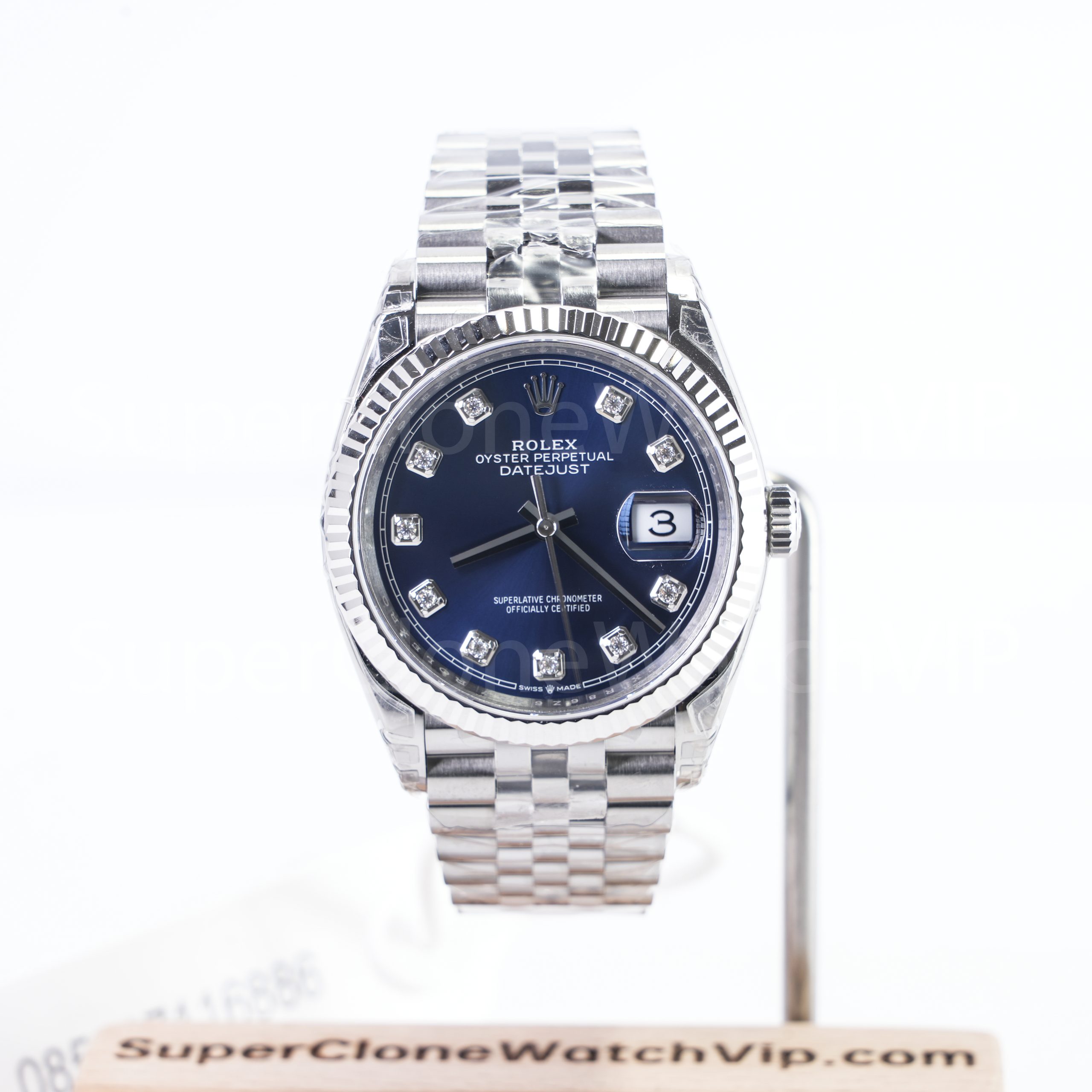
Datejust-Style Lens and Date Window Check
This Datejust-style example shows why the magnifier, dial markers, fluted-style bezel, blue dial, and bracelet reflections should be reviewed as one visual group.

Submariner Date Crystal and Lens Check
This Submariner Date-style example shows how the lens should be reviewed together with bezel alignment, crown-side profile, black dial contrast, and crystal reflection.
Key Details to Check Around the Lens
A useful review starts with the date area, then expands to the whole watch. Otherwise, one small detail may receive too much attention while more important alignment or finishing points get missed.
Date Magnification
Date magnification refers to how large the number appears through the raised lens. Ideally, the number should look clear and easy to read. However, it should not look heavily stretched, blurry, or oddly distorted across every photo.
Camera distance can change the impression. A close-up may make the number appear larger, while a full-watch photo may make it look smaller. Therefore, consistency across the QC set matters more than one dramatic image.
Date Window Alignment
Date window alignment means the number should sit in a balanced position inside the window. For example, it should not look too high, too low, too far left, or too far right in a straight-on image.
Still, a single photo can mislead. If the watch is tilted, the date may appear off-center even when the actual wheel position is acceptable. Because of that, front-facing QC photos are more important than side-angle shots for alignment.
Cyclops Position
The lens should sit directly above the date window. Still, photo angle can create a false sense of tilt. Therefore, front and angled views should be compared before forming a final opinion.
If the lens appears shifted in one image but looks centered in another, the issue may be camera perspective. However, if several straight-on photos show the same tilt, a clearer date-window close-up should be requested before approval.
Crystal Clarity
Crystal clarity affects how sharp the date and dial appear. In addition, strong glare can hide the true lens edge. A clearer close-up is useful when haze, blur, or repeated distortion appears in several photos.
Protective film can also create lines, dust marks, or reflection patches. Therefore, a mark that appears once may not mean the crystal is flawed. If the same mark appears in every angle, it deserves a more careful check.
Details on Super Clone Watches and Replica Watches
In higher-grade super clone watches, the Cyclops lens is one checkpoint inside a wider inspection process. It can show whether the crystal, dial opening, date wheel, and assembly look visually consistent. However, it should not replace a full QC review.
Factory version also matters. Different versions may use different crystals, date wheels, dial printing, and case sets. As a result, two similar Datejust or Submariner Date styles can show different date magnification and window balance.
Movement option can also affect date behavior. Some configurations may show smoother date setting or more stable date-wheel placement. Still, movement claims should stay realistic unless the exact option has been confirmed through the support process.
For broader category research, the Rolex replica watches collection is the most relevant starting point. For factory-version comparison, the Super Clone Watch Factory Guide explains why model-first comparison matters.
QC Photo Checklist Before Shipping
Before shipping, the QC set should make the date area easier to judge. In addition, it should show the full watch clearly enough to review proportions, finishing, and visible alignment.
- Straight-on dial photo to check lens position above the date window.
- Close-up date photo to review date magnification and number clarity.
- Date centering check to confirm balanced placement inside the window.
- Angled crystal photo to review lens tilt, reflection, and edge cleanliness.
- Crystal clarity check for haze, blur, heavy glare, or repeated distortion.
- Dial alignment check for markers, hands, printed text, and overall balance.
- Case proportion review for lugs, crown guards, and side profile.
- Bezel and crown detail check for marker position and crown-side balance.
- Bracelet and clasp finishing review for brushing, polish, links, and closing appearance.
- Final full-watch view to confirm the watch looks visually controlled as a whole.
For the pre-shipping review flow, use the Super Clone Watch QC Process page as the main internal reference.
Why Straight-On and Angled Photos Both Matter
A straight-on photo is the best starting point for date-window alignment. It reduces perspective distortion and makes the date position easier to judge. Therefore, it should carry more weight than a dramatic macro shot.
At the same time, an angled photo adds useful context. It can show whether the lens edge looks even, whether glare hides the date, and whether the crystal area remains clear. In short, the front view checks placement, while the angled view checks depth and reflection.
Close-up photos should be read carefully. A phone camera placed too close can make the lens look more curved than it appears in normal viewing. Because of that, a full-watch photo should always support the detail shot.
Datejust Notes: Why the Lens Looks More Noticeable
Datejust styles often have cleaner dial layouts, so the date window can become a stronger focal point. Therefore, the lens, date number, dial markers, bezel reflection, and bracelet type should be reviewed together.
A fluted-style bezel can create extra light around the crystal. Meanwhile, a darker dial can make the date window look more visible. As a result, crystal clarity and date centering can look different depending on dial color and lighting.
Bracelet choice also changes the overall impression. Jubilee-style bracelets create more small reflections, while Oyster-style bracelets feel cleaner and more direct. However, neither bracelet type can hide a weak date-window area in clear QC photos.
For series research, the Datejust collection is the best internal page to compare dial, bracelet, and bezel directions.
Submariner Date Notes: Crystal, Bezel, and Case Balance
Submariner Date styles place the lens inside a stronger sports-watch frame. The bezel, crown guards, and bracelet create more visual weight. However, the date area still needs clean alignment and readable magnification.
Bezel alignment also matters because the eye compares the 12 o’clock marker, dial markers, and date window quickly. If the bezel marker and date area both look balanced, the watch appears more controlled.
Crystal reflection can be stronger on black-dial Submariner Date styles. Therefore, the photo set should include a clear front view and a moderate angled view. These two angles help separate normal glare from actual lens or crystal concerns.
For sports-model comparison, the Submariner collection supports a more focused review of date and no-date options.
Factory Version and Movement Option: What to Confirm
Factory version should be confirmed by model, not by a general factory name alone. A factory may perform well on one Rolex-style model and less consistently on another. Therefore, date-window watches should be checked through the exact model and actual QC photos.
For a Datejust-style watch, the review should focus on dial markers, date window, Cyclops position, bracelet choice, bezel finish, and case size. For a Submariner Date-style watch, the review should add bezel marker alignment, crown guards, crystal reflection, and bracelet clasp feel.
Movement option should also be discussed carefully. It can affect date setting and date-wheel behavior, but unsupported movement claims should not decide the order. In practice, the safer route is to confirm available options with support and then review the actual QC set before approval.
Practical Buying Advice Before Payment
A date-window watch should be selected through both style fit and detail review. First, choose whether the preferred direction is a dressier Datejust profile or a sportier Submariner Date profile. Then, confirm the factory-version direction and QC process before payment.
For a safer decision path, prepare the exact model link, preferred factory version, wrist-size concern, and the main QC question. For this topic, the main QC question may be simple: “Please show the date window and Cyclops lens from a straight-on angle and a slight side angle.”
The next step should be clear after reading. Browse the related collection, compare the model examples, read the QC process, and send the specific date-window question before payment. This gives support a concrete checklist instead of a vague request.
Realistic Expectations Before Approval
A clear QC review can reduce uncertainty, but it should not create exaggerated expectations. The goal is to review visible finishing, date alignment, crystal clarity, bracelet construction, case proportions, and factory-version notes in a practical way.
For example, a clean lens does not confirm every part of the watch. It also does not prove water performance or movement identity. Therefore, visible photo checks should stay focused on details that images can actually show.
Likewise, one imperfect photo does not always prove a real issue. Light, angle, protective film, and camera distance can change the view. Therefore, a clear follow-up photo is more useful than a rushed judgment.
FAQ
What does the Cyclops lens do on a date-window watch?
The Cyclops lens magnifies the date window, making the number easier to read. However, it also affects dial balance. Therefore, QC photos should show whether the lens sits cleanly above the date, whether the number looks centered, and whether the crystal remains clear.
Why can the date look off-center in QC photos?
The date can look off-center because of camera angle, light reflection, crystal curve, or actual date-wheel position. Therefore, a straight-on dial photo should be reviewed first. In addition, an angled crystal photo can help separate normal reflection from a real alignment concern.
Should date magnification look the same in every photo?
No. Magnification can change visually because of distance, lens angle, phone camera distortion, and lighting. Still, the date should remain readable and balanced across the photo set. If every image shows strong blur or distortion, a clearer close-up is worth requesting.
What QC photos are most useful before shipping?
A useful set includes a straight-on dial photo, date-window close-up, angled crystal view, case-side photo, bracelet photo, clasp photo, bezel view, and crown-side view. Together, these images show the lens, dial, case, bracelet, and finishing more clearly than one close-up.
Does a clean Cyclops lens confirm the whole watch quality?
No. A clean lens is only one checkpoint. Dial alignment, case proportions, bracelet finishing, clasp condition, bezel details, crown shape, and factory-version notes should also be reviewed. Therefore, the lens should support a wider QC review rather than replace it.
Can water performance be confirmed from crystal photos?
No. Water performance cannot be confirmed from photos. A watch may look well finished, but seals, assembly, and testing determine water resistance. Therefore, water exposure should not be assumed from crystal clarity, crown shape, or case appearance alone.
Summary and Practical Next Steps
The Cyclops lens is a small detail with a large visual effect. It influences date readability, dial balance, crystal impression, and the overall look of Datejust and Submariner Date styles. Therefore, it deserves careful attention during pre-shipping QC.
At the same time, the lens should not be judged in isolation. A stronger review also checks dial alignment, case proportions, bracelet finishing, clasp quality, bezel details, crown shape, factory version, and photo angle.
- First, review the relevant Datejust or Submariner collection before choosing a model.
- Next, compare QC photos against the lens, date, crystal, dial, case, bracelet, and clasp checklist.
- Finally, read the QC Process and confirm factory-version questions with SuperCloneWatchVIP support before payment.
In short, rolex cyclops lens explained works best as a practical QC topic, not just a glossary term. A calm review of date magnification, lens position, crystal clarity, and photo angle can make the final decision clearer.
Review the Model, QC Process, and Factory Notes First
Before payment, compare the relevant Rolex collection page, read the QC Process, and prepare specific questions about the lens, date window, crystal clarity, and factory version. For faster support, send the model link, preferred factory-version direction, wrist-size concern, and the exact QC photo request.