Clean vs VSF Submariner is not a single-winner question. If crystal clarity and the date view are your first priorities, one shortlist may make more sense; if bezel execution, case definition and bracelet finishing matter more, the shortlist can change. The answer also shifts between a date reference and a no-date reference because removing the Cyclops and date wheel changes what deserves the most scrutiny.
Use the exact reference first, rank the three details you care about most, and approve only the prepared watch that proves those details in current QC photos and function video.
Start With the Exact Submariner Reference
A factory preference becomes useful only after the reference is fixed. A modern black date model, a green-bezel Starbucks, a two-tone Bluesy and a no-date black model do not place the same pressure on the same components. The colorway changes what the eye notices, while the date configuration decides whether crystal magnification and date-wheel behavior belong near the top of the decision.
The reference number also prevents a common comparison error: applying comments about one case generation to another. A buyer looking at a 40mm date reference should not automatically import every conclusion from a 41mm version. Lug shape, crown-guard profile, bracelet proportions, clasp construction and movement configuration must be checked against the watch actually being offered.
| Reference Route | Configuration | What Becomes Most Visible | First Approval Action |
|---|---|---|---|
| 116610LN / modern black date route | Black dial, black bezel, date and Cyclops | Date centering, crystal view, bezel triangle, dial symmetry and clasp feel | Request straight front photos with both single- and double-digit dates |
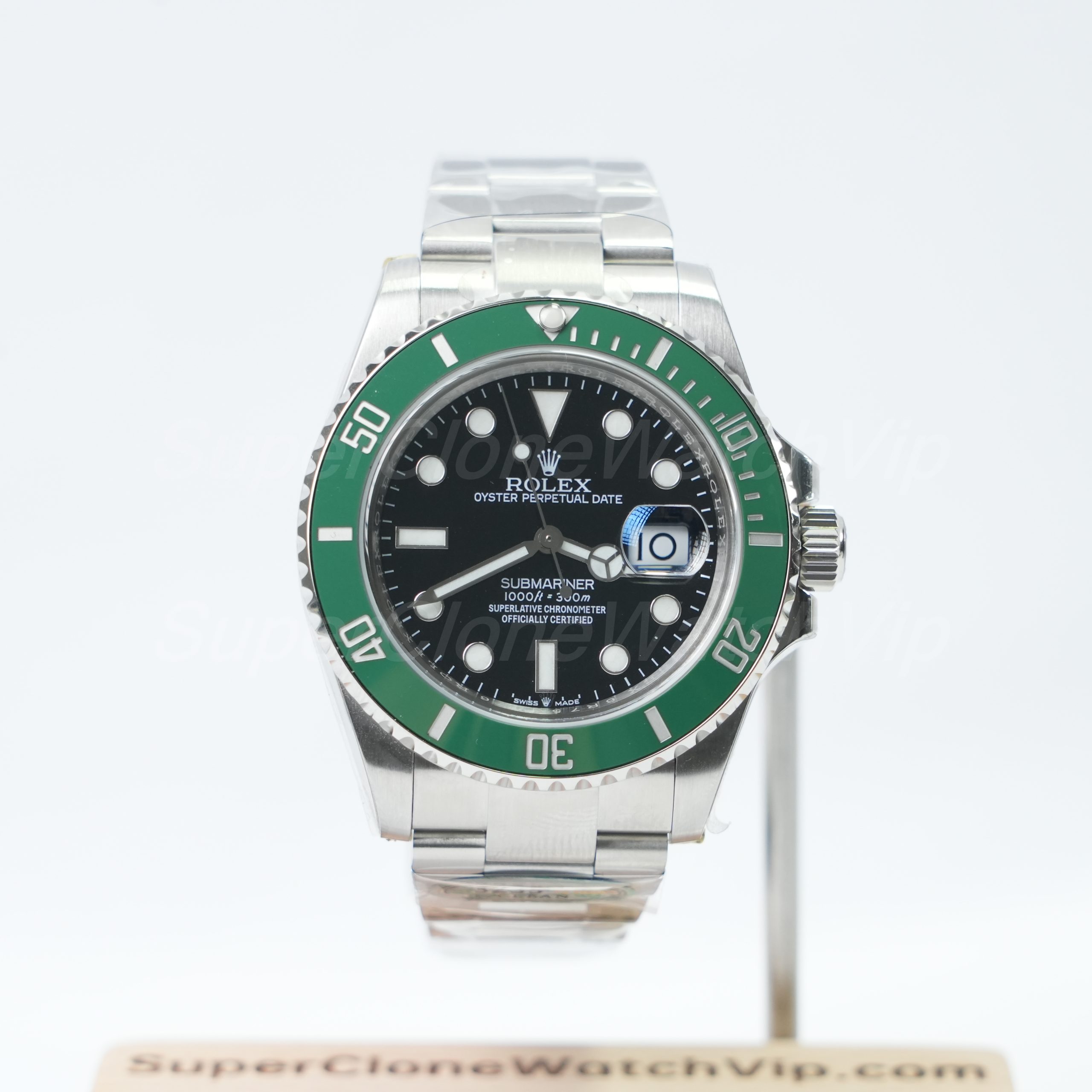
| 126610LV Starbucks route | Green bezel, black dial, date and Cyclops | Green insert tone, pearl position, bezel alignment and date presentation | Compare front, angled and neutral-light bezel photos before judging color |
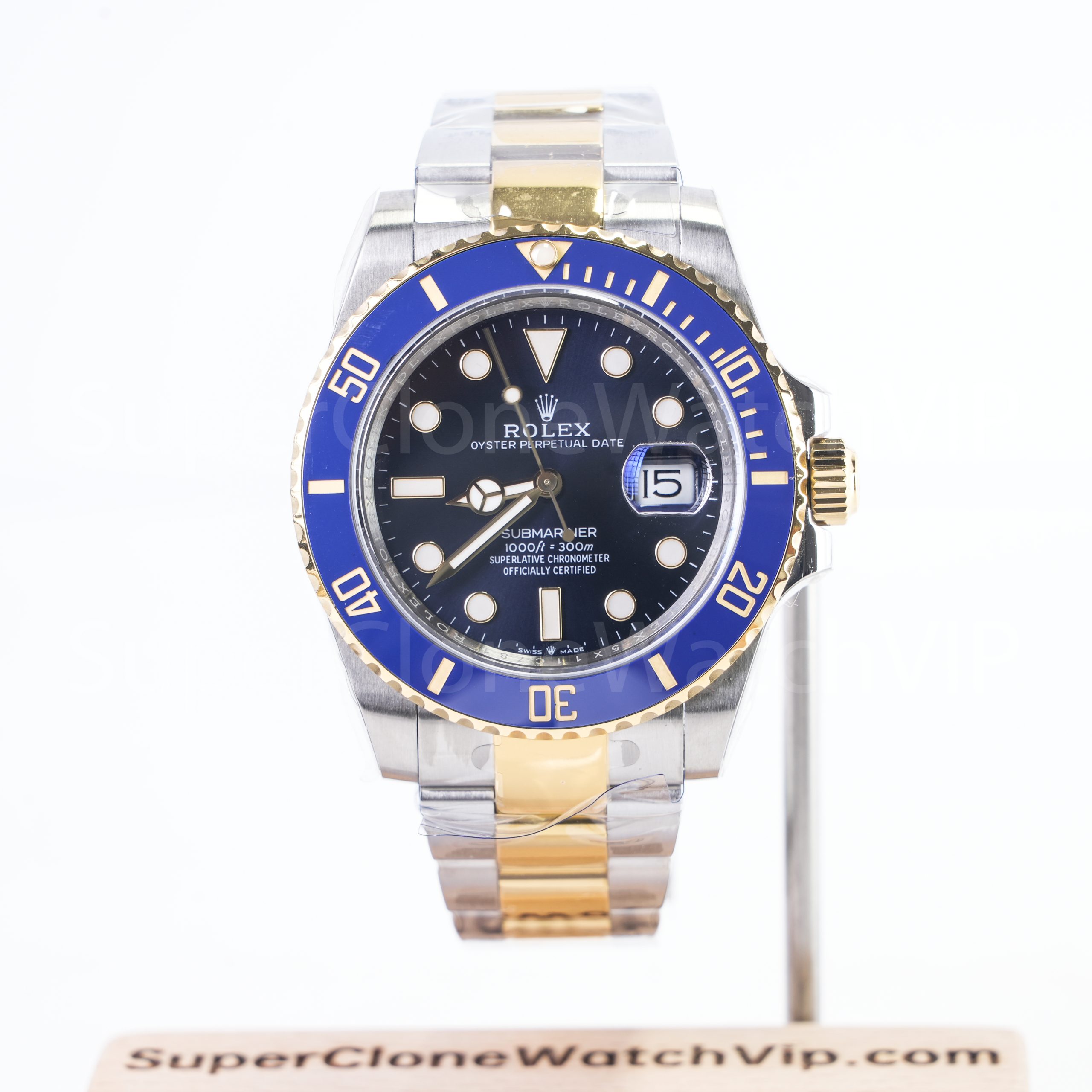
| 126613LB Bluesy route | Blue dial, blue bezel, two-tone case and bracelet, date | Blue color balance, gold-tone consistency, center-link finish and date view | Ask for several lighting angles plus bracelet and clasp close-ups |
| 124060 no-date route | Black dial, black bezel, symmetrical no-date layout | Marker spacing, dial print, rehaut alignment, crystal neutrality and bezel centering | Remove date-related criteria and compare the exterior more strictly |
If you are still comparing this model family with other replica watches, complete that broader browsing first. For this page, the Rolex Submariner collection is the correct place to confirm which reference and color route you are discussing. Product-page photos help identify the model, but factory attribution and final approval still require current evidence for the exact watch.

Dial, Crystal and Date-Magnification Priorities
On a date Submariner, the crystal is not just a transparent cover. It controls how the dial, rehaut and date window are seen together. Buyers who are sensitive to reflections, edge distortion or the date presentation often place VSF high on the shortlist. Buyers who care more about exterior sharpness may still prefer to begin with Clean. That is a starting assumption to test, not a reason to approve a watch unseen.
Use a straight front photo before looking at angled glamour shots. The camera should be centered on the dial, the watch should sit level, and the lighting should not hide the date window. Then ask for at least one single-digit and one double-digit date. A date that looks centered at “8” can sit differently at “28,” so one example is not enough.
Check Cyclops placement, apparent magnification, crystal clarity, date-wheel centering, date-font consistency and whether the window remains readable from a normal wrist angle.
The date advantage disappears. Give more weight to dial symmetry, marker placement, rehaut alignment, crystal reflection and the relationship between the bezel triangle and 12 o’clock marker.
Separate dial color from crystal behavior. Ask for neutral-light photos so a cool camera setting does not make the crystal or dial appear better or worse than it is.
The dial itself should be reviewed at the same time: crown logo position, text sharpness, marker spacing, hand alignment, minute track and visible dust. A strong crystal cannot compensate for a tilted marker, and a sharp dial cannot compensate for a distracting date window. Treat the complete front view as one system.
Bezel Insert, Pearl and Rotation Alignment
The bezel is where Clean often enters the conversation first, especially for buyers who prioritize the insert, engraved numerals, case-edge definition and bracelet presentation. The useful question is not “Which factory has the better bezel?” but “Does this prepared insert suit this exact colorway, and does it align correctly on this watch?”
Start with the triangle at 12 o’clock. It should line up with the dial’s 12 o’clock marker when the bezel is returned to zero. The pearl should sit centered inside the triangle and should not look tilted, crowded or unusually high. Ask for a straight photo and an angled photo because a pearl can appear centered from one position and offset from another.
Color-specific rule: Starbucks requires several neutral-light views of the green insert; Bluesy requires the blue insert, blue dial and gold-tone details to be judged together; a black bezel makes small alignment errors more obvious because the design is visually quieter.
Still photos can confirm insert seating, numeral fill, pearl position and zero alignment. They cannot confirm the full rotation. Request a short video that shows the bezel moving through several clicks and returning to zero. Listen for inconsistent clicks, look for excessive back-play, and confirm that the final resting point does not stop visibly to one side.
Do not reject a bezel only because one close-up looks slightly off-axis. Camera angle and parallax can create false misalignment. Ask for a centered front image with the watch level, then compare the bezel triangle, dial marker and rehaut centerline in the same frame.
Case Shape, Rehaut and Crown-Guard Checks
A front photo can make two watches look nearly identical while the side profile tells a different story. Compare the mid-case height, crystal height, caseback transition, lug shape and the way the bracelet leaves the case. This is especially important when comments about one Submariner generation are being applied to another.
The crown side deserves its own frame. Crown guards should appear even and should flow into the case rather than looking abruptly thick or thin. Check whether the crown sits straight, whether the brushed and polished surfaces meet cleanly, and whether the guard shapes are visually balanced above and below the crown.
| View | Inspect | Pause the Approval When |
|---|---|---|
| Straight front | Lug symmetry, dial opening, bezel seat and rehaut relationship | The watch is clearly tilted or the framing prevents a reliable alignment check |
| Crown side | Crown-guard shape, crown seating, polish and case thickness | The guards look uneven or the crown appears visibly canted |
| Opposite side | Mid-case height, crystal profile and caseback transition | Only the crown side is supplied and the thickness cannot be compared |
| Rehaut close-up | Engraving visibility, center position and alignment around key markers | The angle or reflection hides the area you are expected to approve |
Rehaut alignment should be judged as an overall pattern, not by one letter photographed at an angle. Use the 12 and 6 o’clock areas as practical anchors, then scan around the dial for abrupt shifts. Small photographic distortions are normal; a consistent visible offset in a centered image deserves a follow-up photo.
Bracelet, Clasp and Glidelock Evaluation
The bracelet is not a secondary cosmetic item. It controls daily comfort, how the watch balances on the wrist and whether the exterior quality feels consistent from case to clasp. Clean is frequently shortlisted by buyers who put bracelet and exterior finishing near the top, but the prepared bracelet still has to prove itself.
Ask for the bracelet fully opened, not only wrapped around a display cushion. The end links should meet the case cleanly, the link spacing should look even, the taper should appear symmetrical and the brushing direction should remain consistent. On a two-tone Bluesy, inspect the transitions between steel-colored outer links and gold-tone center links under more than one angle.
Check front and side fit, visible gaps, seating height and whether both sides look balanced.
Review brushing, polished edges, logo placement, engraving, safety-lock position and visible scratches.
A short video should show the clasp opening, closing and locking without forced handling or obvious looseness.
Ask to see the adjustment track, several positions and secure re-engagement after the bracelet length changes.
Glidelock QC is functional as well as visual. A still photo can show the track and clasp interior; only a video can show whether the adjustment releases, slides and locks correctly. Include this test before approval if wrist fit and frequent micro-adjustment are important to you.
Movement and Date-Change Function Testing
Do not infer the movement only from the reference number or factory name. Ask the seller to state the factory, version and movement supplied for that exact watch in the same message. The goal is not to turn a visual comparison into a movement ranking; it is to make sure the quoted configuration and the demonstrated functions agree.
For every model, request a short video showing manual winding, time setting, crown operation and the seconds hand running. For date models, add quick-set date operation and a controlled date-change demonstration. The date should advance cleanly, and the crown positions should be explained without forcing the mechanism on camera.
Function sequence to request
- Show the watch running before the crown is touched.
- Unscrew the crown and demonstrate manual winding with normal handling.
- Move to the time-setting position and show the hands responding correctly.
- On date references, demonstrate quick-set date operation and a date transition.
- Return the crown, screw it down and show that it seats evenly against the case.
A no-date model simplifies this stage because there is no date wheel, Cyclops or date-change behavior to judge. That does not make movement confirmation optional. It means the comparison shifts toward winding feel, time setting, crown operation, running behavior and the exterior areas that are now more visually dominant.
For broader technical background, use the Rolex super clone movements guide. Keep the present page focused on how movement and date functions change a Submariner-specific Clean–VSF decision.
Clean or VSF by Buyer Priority
The matrix below is not a scorecard and does not declare a permanent winner. It converts reference type and personal priorities into a shortlist, then defines the evidence required before the shortlist becomes an approval.
Choose three priorities only. Ranking every component as equally important usually leads back to generic factory arguments. A practical set might be “crystal, date and case profile” or “bezel, bracelet and clasp.” The prepared watch should then be judged against those three areas first.
| Reference / Use Case | Your First Priority | Clean Shortlist Makes More Sense When | VSF Shortlist Makes More Sense When | Budget / Approval Rule |
|---|---|---|---|---|
| Black date Submariner | Date view, crystal, bezel alignment or daily comfort | The insert, case edges, bracelet finish and clasp presentation lead your list | Crystal clarity, Cyclops view, date presentation and overall wrist profile lead your list | Do not pay a premium until two date examples and a function video prove the advantage you value |
| 124060-style no-date | Dial symmetry, bezel, case, rehaut or bracelet | Exterior definition, bezel execution and bracelet finishing are the main reasons for buying | Crystal neutrality and overall case profile still look stronger in the current evidence | Remove all date-related claims from the comparison; pay only for visible exterior or movement evidence |
| 126610LV Starbucks | Green insert tone, pearl, date view or case profile | Bezel surface, numeral fill, pearl and exterior edges are the deciding details | Crystal, date presentation and balanced front view outweigh small exterior preferences | Require neutral-light bezel photos; do not spend more based on a heavily edited green tone |
| 126613LB Bluesy | Blue dial depth, bezel color, two-tone finish, crystal or date | Bezel printing, bracelet transitions, center links and clasp finish dominate your decision | Dial view, crystal, date presentation and overall wearing balance dominate your decision | Approve only after several light angles show consistent blue and gold-tone balance |
| Older 40mm or less-discussed version | Reference-correct shape and current availability | Current Clean evidence matches the exact generation and requested exterior details | Current VSF evidence matches the exact generation and requested crystal or profile details | Ignore rankings written for another generation; compare the exact offered batch and QC set |
A simple way to use the matrix
Write one line before asking for stock: Reference + priority 1 + priority 2 + priority 3. Example: “126610LV; green insert and pearl; crystal/date view; case profile.” Ask for current Clean and VSF availability only after that line is fixed. This keeps the comparison tied to the model rather than turning it into a general factory ranking.
Submariner QC Evidence Required Before Approval
The final decision must be made from the prepared watch, not a product-card image or a factory sticker shown by itself. Ask for enough evidence to connect four things: the reference requested, the factory/version quoted, the visible component priorities and the working functions.
A complete set should be easy to audit. Save the product link or reference image first. When QC arrives, compare the same details in the same order every time rather than moving randomly between photos.
Identity evidence
Exact reference, dial/bezel color, date or no-date configuration, quoted factory, version and movement statement.
Front-view evidence
Centered dial, angled dial, bezel close-up, pearl, crystal, rehaut and date examples when applicable.
Case evidence
Crown side, opposite side, lug shape, crown guards, caseback transition and crown seating.
Bracelet evidence
End links, full bracelet, clasp exterior/interior, engraving, screws, Glidelock track and adjustment video.
Function evidence
Winding, time setting, crown operation, bezel rotation, clasp action and date change for date references.
Decision record
Your three priorities, any follow-up images requested and the final approval tied to the same watch.
Message format for factory-version confirmation
“Please confirm the exact Submariner reference, Clean or VSF factory, current version and movement for this watch. My priorities are [1], [2] and [3]. Before approval, please send centered dial photos, bezel and pearl close-ups, both case sides, bracelet and clasp photos, Glidelock operation, crown/time-setting video and date examples if applicable.”
The site’s QC process explains the broader pre-shipping review. For this comparison, the added requirement is to connect every requested photo or video to the exact reference and the three priorities chosen from the matrix.
Clean vs VSF Submariner FAQ
Choose by Reference, Then Lock Three Priorities
A useful Clean–VSF decision can fit on one line: the exact Submariner reference followed by the three details you care about most. A date buyer may write “crystal, date and case profile.” A Starbucks buyer may write “green insert, pearl and date view.” A Bluesy buyer may write “dial depth, two-tone bracelet and clasp.” A no-date buyer may write “dial symmetry, bezel and rehaut.”
Send that line with the reference link, ask which current Clean and VSF versions are available, and request evidence for those priorities. Do not approve because one factory won a general discussion; approve because the prepared watch for your reference passes the three checks you selected.