Think back over the last 12 months: did you start a timer more often, or check another time zone more often? That habit resolves Daytona vs GMT-Master II more reliably than fame or bezel color. Choose Daytona when elapsed-time operation and a chronograph layout will be used; choose GMT-Master II when home time, travel, or overseas calls create repeat value.
Use the current Daytona replica watches and GMT-Master II replica watches pages to compare the exact configurations available. For broader model browsing, the main replica watches page should remain a secondary step, not the basis of this decision.
Article navigation
Two Complications, Two Different Habits
The Daytona asks you to operate a timing system. You start, stop, read and reset a chronograph. The GMT-Master II asks you to maintain a reference time. Once the extra hand is set, it continues to show a second time zone without requiring a new action each time you look at the watch.
That difference changes the buying logic. A chronograph creates value through deliberate use: timing a task, a journey, an interval or another event. A GMT display creates value through repeated checking: home time while travelling, a client’s working hours, an overseas family member’s time or a second operational time zone.
Before comparing finishes or dial colors, write down the number of times you realistically expect to use each function during the next 12 months. Do not count situations where a phone would clearly be faster unless you genuinely prefer using the watch.
Core comparison for the exact decision
Chronograph Subdials vs a Fourth GMT Hand
A Daytona-style dial separates normal timekeeping from chronograph information. On a properly described functional configuration, the central chronograph seconds hand and one or more subdials record elapsed time, while another subdial may carry the running seconds. The exact counter mapping can vary by version, so the product description and the functional video must agree.
A GMT-Master II keeps the normal hour and minute reading familiar. The fourth hand points to a 24-hour scale, allowing a second reference time to be read. It requires an initial learning step, but the information remains continuously available after setting.
The 15-second Daytona test
Look at a front-facing product or QC image at normal phone size. Confirm that you can identify the current hour and minute without mistaking the central chronograph hand for normal seconds. Then identify which subdial is supposed to show running seconds.
The 15-second GMT test
Read local time first, then trace the GMT hand to the 24-hour scale. If that sequence feels natural, the complication will have low learning friction. If the extra hand is visually distracting, do not assume travel use will fix the issue.
For many buyers, the GMT layout is faster for ordinary time reading because the center of the dial is less segmented. Daytona becomes the better interface only when the chronograph information is welcome rather than tolerated.
Bezel Reading and Information Density
The two bezels are not interchangeable design details. Daytona uses a fixed tachymeter-style scale associated with measuring average speed over a known distance. It does not serve as a rotating countdown bezel, and buyers who never use that scale should treat it as visual information rather than daily utility.
GMT-Master II uses a 24-hour bezel as part of the second-time-zone system. The bezel can shift the reference displayed by the GMT hand, depending on how the wearer sets and reads it. This creates more practical travel value but also makes bezel alignment and rotation part of the inspection.
Do not let this article become a bezel-color ranking. Color changes wrist presence, but the functional decision comes first: fixed timing scale versus adjustable 24-hour reference.
Action before shortlisting
Shrink both product images to the size they will occupy on your wrist in a mirror photo. If the Daytona subdials merge into visual noise, remove it from the shortlist. If the GMT bezel dominates more than the time display, choose a quieter configuration within the GMT category rather than changing the entire functional direction.
Case, Pushers and Crown in Daily Use
The Daytona case carries two pushers beside the crown. Even when the overall watch looks visually compact, those controls add width and create more contact points near a cuff or wrist bone. A buyer who plans to use the chronograph should also confirm how the pusher collars and buttons operate on the exact version rather than assuming every listing behaves identically.
A standard GMT-Master II has fewer external controls during normal use. The crown handles time and date setting, while the bezel is used to change the 24-hour reference. This usually makes the interaction simpler after the GMT hand is learned.
The Sprite example shown later is a left-handed configuration with the crown and date on the opposite side from standard GMT layouts. It should not be used to judge the entire GMT-Master II family. Check crown position on the exact product before ordering.
Ask for three comfort views
- A straight side profile to show case height, crown, pushers and caseback position.
- A short bracelet-and-clasp movement clip to show articulation and closure.
- A wrist or curved-surface view, when available, to judge how the lugs and end links sit.
Travel Routine vs Motorsport Aesthetic
The cleanest way to separate utility from attraction is to ask what happens after the first month. A GMT hand can remain useful for recurring overseas calls, remote teams, family in another country or regular travel. The benefit is passive: glance, read and continue.
A chronograph creates value only when the wearer chooses to start it. It can time parking, cooking, exercise intervals or a journey, but the function competes with phone timers. Daytona still makes sense when operating a mechanical-looking timer is part of the enjoyment, yet that is an aesthetic-and-interaction decision rather than automatic daily utility.
Use this rule: when one complication is likely to be used at least six more times per year than the other, follow the higher-use function. When both are rarely used, prioritize read speed, case comfort and the amount of QC verification you are willing to complete.
Two current product directions to inspect

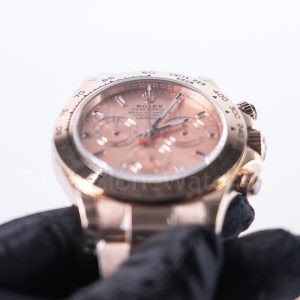
Daytona 126500LN White Panda example
Use this listing to inspect chronograph dial density, pusher position, fixed bezel printing and the stated functional specification. Do not approve it from a still image alone when chronograph operation matters.
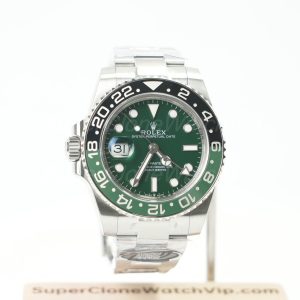
GMT-Master II 126720VTNR Sprite Oyster example
Use this listing to inspect the fourth hand, date position, rotating 24-hour bezel and left-handed control layout. Confirm that the reversed crown side suits the intended wrist.
Functional Video QC for Each Model
Still photos can show printing, alignment and finishing, but they cannot prove a complication completes its full operating sequence. Ask whether a functional video is available before ordering when the complication is part of the reason for choosing the watch. The site states that video proof may be provided when available, so it should be requested rather than assumed.
Daytona functional sequence
- Show the front view before operation and confirm the central chronograph hand is at its stated zero position.
- Start the chronograph and show the intended central hand moving.
- Run it long enough to demonstrate that the seller-stated counter advances. Confirm which subdials are functional rather than assuming every register is active.
- Stop the chronograph and show that the hands hold their positions.
- Reset it and confirm the indicated chronograph hands return cleanly to zero.
- Show pushers, crown, side profile, clasp and bracelet movement after the function test.
GMT-Master II functional sequence
- Show the crown-setting sequence and identify how the normal hour, minute and GMT hands relate.
- Set a clearly different second time and show it being read against the 24-hour scale.
- Demonstrate the date-setting or date-change function stated for the exact version.
- Rotate the bezel in both directions when applicable, then return the triangle accurately to 12 o’clock.
- Pause on a straight front view to check bezel, hand and date alignment.
- Finish with the crown side, clasp, end links and bracelet movement.
Use the site’s QC photos before shipping page for the still-image sequence and the video proof before shipping page for what can be shown in motion.
Which Complication Deserves Space on Your Wrist?
A complication deserves space when its benefit is greater than the reading, comfort and inspection cost it creates. Apply the following filters in order.
Choose Daytona when
You expect to operate elapsed timing at least a few times each month, or the act of using a mechanical-style chronograph is itself part of the appeal. You are also prepared to review a longer function video.
Choose GMT-Master II when
You check another time zone weekly, travel repeatedly, work with overseas schedules or want a date-and-dual-time layout that remains useful without starting a function.
When neither function will be used
GMT-Master II generally retains more passive utility through conventional time, date and a continuously visible reference hand. Daytona can still be the more controlled visual choice, but the decision is then aesthetic rather than functional.
A tie should be broken by the watch you can read faster and verify more confidently. Do not use model fame as the tiebreaker.
Usage-Frequency Decision Chart
This chart is a practical assessment tool, not a manufacturer rating. Fill it in using your next 12 months rather than your last product-photo reaction.
Four-step decision tree
1. Forecast use
Estimate chronograph starts and second-time-zone checks for the next year.
2. Remove imagined use
Delete occasions where you know you will reach for a phone instead.
3. Follow a clear gap
When one function leads by six or more uses per year, choose it.
4. Break a tie
Choose faster reading, better case comfort and the QC sequence you can verify.
FAQs About Daytona vs GMT-Master II Functions
Which function is more useful for frequent travelers?
The GMT function is normally more useful because it keeps a second reference time visible without starting a timer. It has repeat value for flights, overseas work, remote teams and family in another time zone.
Does a Daytona require more video testing?
Yes, when chronograph function matters. A useful video should show start, counter progression, stop and reset, plus the return of the relevant hands to zero. A GMT video usually needs fewer operating stages.
Is a GMT dial easier to read than a chronograph?
For ordinary hour-and-minute reading, usually yes. A GMT dial adds one hand but avoids the three-register layout of a chronograph. Reading the second time still requires learning the 24-hour scale.
Which model feels more versatile without using the complication?
GMT-Master II often retains more passive utility because conventional time, date and the reference hand remain continuously available. Daytona may look more controlled in a neutral configuration, but its unused complication still occupies more dial space.
What should the QC video show for each function?
For Daytona, request start, visible progression, stop, reset and zero return. For GMT-Master II, request the hand-setting relationship, second-time reading, date function, bezel rotation and final alignment. Both videos should also show the crown side, bracelet and clasp.
Choose by the Next 12 Months, Not by Model Fame
Write two numbers before ordering: expected chronograph uses and expected second-time-zone checks. The larger number should lead the decision. When the numbers are close, compare read speed, case controls and the functional video sequence you are prepared to review.
Send one Daytona link and one GMT-Master II link, then ask for the model-specific QC actions listed above. That gives the comparison a verifiable ending instead of another popularity verdict. Buyers still exploring the wider catalogue can browse clone watches only after this function test is complete.