The 5711 is built around visual simplicity and a slim sports-watch profile, while the 5712 adds an asymmetrical dial and several functions that create a different set of risks. That is why the PPF vs 3KF Nautilus 5711 5712 comparison cannot produce one automatic factory winner for both references. A 3KF 5711 may deserve priority when case profile and clone-style movement architecture matter most, while a PPF 5711 may remain attractive when the prepared watch shows a stronger dial, date window and out-of-box finish. The 5712 must be judged separately through actual function proof, not inherited reputation.
Factory tendencies are useful for building a shortlist, but batches, dial colors and prepared pieces can vary across replica watches. The final decision should connect one reference, one stated factory version and one complete QC set. This guide shows exactly what needs to be compared before either option is approved.
Separate the 5711 Decision From the 5712 Decision
The first decision is not PPF or 3KF. It is whether the target is a 5711 or a 5712. The two references share the Nautilus case language, but they expose factory weaknesses in different places.
Fewer dial elements expose proportion
The 5711 has a time-and-date layout with little visual distraction. A thick middle case, heavy bezel, uneven blue tone, crooked marker or poorly integrated first bracelet link is therefore easier to notice.
The factory choice should be driven by side profile, dial and date quality, bracelet flow and the importance placed on movement architecture behind the display back.
More displays create more ways to fail
The 5712 adds a moon-phase area, pointer date, power-reserve indication and small seconds. A visually convincing front photo is not enough because hands or displays may be decorative, incorrectly positioned or difficult to operate.
The practical priority is the exact functional version, followed by dial layout, side thickness, movement presentation and a continuous video showing the stated functions.
Reference-first rule: a factory that wins a 5711 comparison does not automatically win the 5712. Rebuild the shortlist whenever the reference changes.
Case Profile, Thickness and Side-View Accuracy
A Nautilus can look convincing from the front and still appear heavy from the side. The inspection should separate total thickness from the individual layers that create it: bezel and crystal, middle case, caseback and the way the case ears meet the bracelet or strap.
What usually separates a 5711 shortlist
Many buyers consider 3KF when the priority is a slim 5711 profile and clone-style movement construction. PPF can read slightly fuller in versions built around a different underlying movement architecture, but a factory name alone does not prove the thickness of the actual watch being prepared.
Ask for both candidates from the same angle whenever possible. The crown should face the camera, the bracelet should not hide the lower case and the watch should rest at a similar height. Compare the middle case rather than judging only the crystal or caseback.
Why the 5712 needs a different side inspection
The 5712 has a more complicated internal layout, so its side profile should not be judged by 5711 expectations. Check whether the caseback protrudes, whether the crown sits visually centered in the case band and whether the case ears look too thick when viewed from the bracelet or strap side.
Blue Dial Tone, Texture and Marker Alignment
Blue Nautilus dials are difficult to judge because the apparent color changes with exposure, white balance, reflection and viewing angle. A grey-blue dial may look saturated in one photograph and washed out in another. One image should never decide whether a PPF or 3KF dial is better.
Use a three-light dial check
Diffuse daylight
Use indirect natural light to judge the base blue or grey-blue tone without strong glare.
Neutral indoor light
Checks whether the dial becomes overly purple, flat grey or unnaturally bright indoors.
Oblique reflection angle
Reveals groove consistency, sunburst response, marker edges and printing thickness.
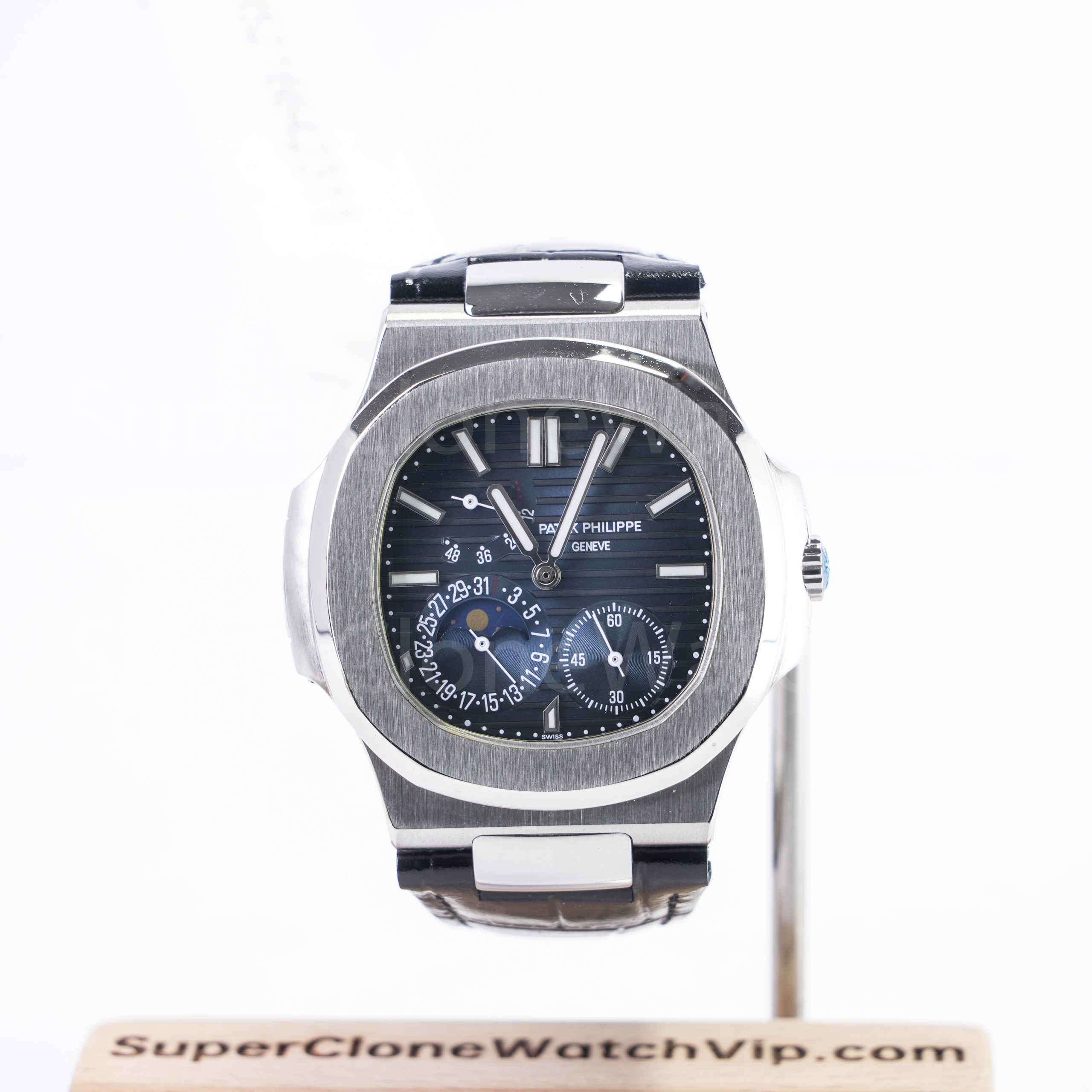
For a 5711, compare the horizontal grooves across the entire dial, the spacing around the logo, the two markers at 12 o’clock and the date window at three. PPF has often been shortlisted for out-of-box dial and date presentation, while 3KF is frequently selected for other structural priorities. The prepared dial still has to earn the decision.
For a 5712, examine each display area separately and then step back to judge the full asymmetrical balance. The moon-phase opening should not dominate the dial, the pointer-date scale should remain legible and the power-reserve hand should sit naturally within its printed arc.
For a dedicated explanation of horizontal grooves, printing, marker finishing and color shifts, see Patek dial textures and lighting checks. That page supports dial inspection without replacing this factory-by-reference comparison.
Reference Examples for Visual Comparison

Bracelet Taper, Link Articulation and Clasp
The Nautilus bracelet is not only a finishing detail. It completes the shape of the case. A strong dial cannot compensate for a first link that sits too high, a bracelet that drops away abruptly or a clasp that closes unevenly.
Do not judge bracelet quality from a flat product photo
Reports on PPF and 3KF bracelet finishing are mixed, and both can feel looser off the wrist than expected. Instead of turning that into an unsupported factory verdict, compare the actual bracelets through identical actions.
Macro photographs worth requesting
- Both case-to-bracelet junctions from above.
- The first three links from the side.
- Brushing direction across the broad center surfaces.
- Polished edge transitions without protective film obscuring them.
- Closed clasp viewed straight from the top and from both sides.
- Inside-clasp engraving, hinge condition and visible gap control.
A leather-strap 5712 can still be evaluated for strap fit, buckle and case transition, but it cannot answer a steel-bracelet comparison. Confirm that both PPF and 3KF candidates use the same bracelet or strap configuration before comparing them.
Movement Appearance and Functional Checks
5711: architecture versus practical ownership
The 5711 movement question is mainly about what the buyer values. Many 3KF versions are selected because their clone-style architecture creates a more reference-specific movement layout and supports a slim case direction. Many PPF 5711 discussions involve a decorated movement built from a different base architecture.
That does not make the decision automatic. A movement that looks more faithful through the caseback may be more important to one buyer, while another may prioritize the cleaner dial, date presentation or a movement type that a local watchmaker is more willing to inspect. The exact current version should be confirmed rather than assumed from an old review.
For either 5711, request a clear caseback photo, a short winding and setting video, running seconds and a controlled date-change demonstration. Rotor sound should be recorded in a quiet environment if noise is a concern.
5712: every stated display needs evidence
PPF is the more commonly documented route for a functional 5712, but the factory name still does not prove that every hand and display on the prepared watch behaves as expected. A listing described as 3KF 5712 should be treated as an individual candidate until the exact factory, version, movement and functions are shown.
Ask for one continuous 5712 function video
- Show the complete watch, dial and caseback before operating it.
- Demonstrate crown positions and normal time setting.
- Show the small seconds running without an unexplained stop.
- Demonstrate how the pointer date is adjusted or advanced.
- Show the moon-phase display advancing through the stated adjustment method.
- Show the power-reserve hand before and after an appropriate winding sequence.
- Return to a full front view so hand clearance and final positions can be checked.
- Show the caseback and movement while the watch is still running.
A cut video can hide resets, non-functional displays or manual repositioning between clips. The useful proof is a continuous sequence that matches the seller’s description of the exact version.
PPF vs 3KF by Reference and Priority
This two-level matrix separates the references first, then compares the five factors that actually change the decision. The entries describe common selection tendencies, not guaranteed specifications for every batch.
Nautilus 5711
Moderate QC difficulty
Thinness and case profile
PPF tendency: may read slightly fuller depending on the underlying movement and current version.
3KF tendency: commonly shortlisted when slim side profile is the leading priority.
Verify: matching crown-side, opposite-side and caseback photographs.
Dial and date
PPF tendency: often considered for stronger out-of-box dial and date presentation in selected batches.
3KF tendency: can require closer attention to blue tone, marker alignment and date details.
Verify: three-light dial set, 12-marker macro and centered date close-up.
Bracelet and clasp
PPF tendency: finishing may look convincing, but articulation and looseness remain piece-specific.
3KF tendency: can wear comfortably and articulate well, but should not be assumed superior without video.
Verify: first-link fit, taper, free-hanging movement and repeated clasp operation.
Movement and functions
PPF tendency: different base architecture may matter less when the movement view is not a priority.
3KF tendency: clone-style layout is a stronger reason to choose it when caseback appearance matters.
Verify: exact movement version, caseback macro, setting action and date change.
Best priority match
PPF fits: buyers who approve the actual dial, date and finishing and place less weight on clone movement architecture.
3KF fits: buyers who prioritize slimness and movement layout after the dial passes QC.
Decision standard: reject any candidate that wins on reputation but loses on the prepared piece.
Nautilus 5712
High QC difficulty
Thinness and case profile
PPF tendency: established 5712 versions still require close checking of middle-case and caseback height.
3KF-labelled option: do not infer 5711 thinness or movement design from the factory name.
Verify: both side views, caseback protrusion and an on-wrist profile clip.
Blue dial and sub-displays
PPF tendency: later dial improvements may not apply to every available batch, so color must still be checked.
3KF-labelled option: exact dial source, printing and display layout should be confirmed rather than presumed.
Verify: three-light dial set plus macros of moon phase, date, reserve and small seconds.
Bracelet, strap and clasp
PPF tendency: bracelet or clasp quality should be reviewed at item level, especially off-wrist looseness.
3KF-labelled option: compare only when the same steel-bracelet or leather-strap configuration is offered.
Verify: case transition, articulation, buckle or clasp operation and protective-film-free macros.
Movement and stated functions
PPF tendency: the more documented functional route, but the exact version still needs proof.
3KF-labelled option: factory identity, movement and function claims must be demonstrated before comparison.
Verify: one continuous video covering crown, date, moon phase, reserve and small seconds.
Best priority match
PPF fits: buyers who want an established 5712 route and receive satisfactory function proof.
3KF-labelled option fits: only when the seller documents exactly what is being offered and it passes the same tests.
Decision standard: function confidence outranks a borrowed 5711 factory reputation.
QC Photos and Videos Needed for Each Model
A generic set of attractive front photographs is not enough. The request should change with the reference and with the factory weakness being tested.
Proportion, dial, date and bracelet proof
- Straight front photograph with the camera centered over the dial.
- Diffuse-daylight and neutral-indoor dial photographs.
- Macro of the logo, paired 12 o’clock markers and date window.
- Crown-side and opposite-side case photographs.
- Bezel corners and polished bevels from two oblique angles.
- Both first-link connections and a full bracelet taper view.
- Closed clasp from above, both sides and inside.
- Caseback and movement macro without heavy reflection.
- Short video showing winding, setting, date change, bracelet drop and clasp action.
Dial-layout and continuous function proof
- Straight front photograph with every display clearly visible.
- Three-light dial set to evaluate blue, grey or purple color shifts.
- Separate macros of moon phase, pointer date, power reserve and small seconds.
- Hand-clearance photograph where the main hands cross the sub-display area.
- Both side profiles and a close caseback angle.
- Bracelet and clasp sequence, or strap, buckle and case-fit macros.
- Movement-side photograph with rotor and plate details in focus.
- One uncut video demonstrating every function claimed for the exact version.
Copyable QC request
“Please confirm whether this is the current PPF or 3KF version for reference 5711/5712. I need matching front and side photos, three dial-lighting views, bracelet or strap macros, clasp details and a clear caseback image. For the 5712, please also provide one continuous video showing crown setting, small seconds, pointer-date adjustment, moon-phase adjustment and power-reserve response. Please identify any display that is decorative or does not operate like the genuine reference.”
The site’s pre-shipping review page is the Super Clone Watch QC Process. For moving views of the case, clasp and bracelet, also review the video proof before shipping page.
FAQ About PPF and 3KF Nautilus 5711/5712
Choose the 5711 and 5712 Under Different Conditions
Let thinness and movement architecture lead only after the dial passes
A 3KF 5711 is the stronger candidate when the prepared watch shows the preferred slim profile, the clone-style movement layout matters and the blue dial, markers and date all pass QC. A PPF 5711 is the stronger candidate when its actual dial, date window, bezel and finishing look better and movement architecture is a secondary concern. Neither should win before the bracelet and clasp are shown in motion.
Let verified functions outrank the factory label
PPF is the more practical 5712 starting point when the seller identifies the exact functional version and supplies satisfactory dial, caseback and continuous video evidence. A watch offered as a 3KF 5712 should remain only a candidate until its factory identity, movement and every stated display are verified. The 5712 decision is complete only when the function proof and side profile are both acceptable.
The next action is a matched evidence set
This reference-specific comparison is more useful than applying one general ranking across all clone watches.
Request the same-angle side views, the same three dial-lighting conditions, the same bracelet or strap configuration and the correct model-specific video from every candidate. That evidence can be placed directly against the decision matrix above, making the final factory choice traceable instead of reputation-based.