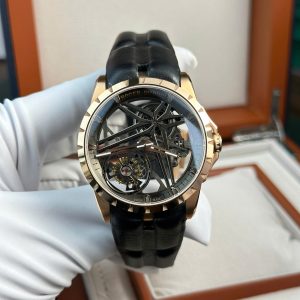
The details that make an RM-style watch look most impressive in photos can also hide its biggest weaknesses: a layered tonneau case and a crowded skeleton dial.
This Richard Mille replica watches buying guide starts with architecture rather than color. It shows how to narrow the model family, judge wrist fit, inspect the case layers, test hand legibility and request video for any moving function before approving the prepared watch.
Article Navigation
Choose the RM Architecture Before the Color
A color-first search is risky because two RM-style watches with similar black, white or blue finishes can wear and function very differently. Start by deciding what type of structure you actually want on the wrist: a chronograph-style layout with pushers, a cleaner open sport layout, a visually slimmer case, or a display-focused model with a prominent moving mechanism.
The practical difference is not simply “sporty versus dressy.” Architecture decides how many parts need checking, how much visual noise sits behind the hands, how far the strap projects from the case and whether a still photo can prove the functions being advertised. Browse the current Richard Mille replica watches collection to identify the family first, then return to the exact prepared watch for QC.
A Family-Level Decision, Not a Factory Ranking
Factory and version information still matters, but it should come after the model family is fixed. A version that looks convincing in a simpler time-only layout may not be the strongest choice for a busy chronograph or a model promoted with a moving display. Ask which version is currently available for the exact reference, then compare the actual case, dial and functions rather than treating one factory name as a universal winner.
RM Model-Family Decision Matrix
Use this as a request checklist, not as a claim that every watch in a family has the same dimensions or functions. The exact product listing and prepared-watch evidence remain decisive.
| Model family | Size feel | Dial complexity | Function risk | Video that is required | Best wrist match |
|---|---|---|---|---|---|
| RM 011-style chronograph layouts | Broad, busy and visually tall | High: hands, sub-dials, date and open details compete | Elevated when multiple pushers or indicators are claimed | Start, stop and reset; crown setting; date change if present | Medium-to-larger wrists or buyers comfortable with strong presence |
| RM 035 / RM 055-style open sport layouts | Bold, curved and strap-dependent | Very high: the time display sits over an open background | Moderate unless an additional moving display is promoted | 360-degree case view, crown setting and any advertised moving display | Medium wrists and above when the first strap section curves down correctly |
| RM 67-style slimmer layouts | Visually slimmer and less top-heavy | High, but usually easier to read when hand contrast is strong | Lower for a simpler time display | Side profile, crown winding/setting and normal running | Smaller-to-medium wrists seeking the RM shape without maximum bulk |
| Display-focused tourbillon-style or transparent-look models | Largest visual footprint and highest attention level | Extreme: every layer and moving area is exposed | Highest because appearance and motion must both be verified | Continuous moving display, crown setting, full side and rear rotation | Medium-to-larger wrists and occasional statement wear |
Case Dimensions and Wrist Fit
A single diameter number is not enough for an RM-shaped case. The upper and lower curves, overall length, side height, crown-side projection and the angle of the first strap segment all change how large the watch feels. A broad case can sit securely when it follows the wrist; a nominally smaller case can wear larger when the strap exits horizontally and holds the watch above the skin.
Before asking for a recommendation, measure wrist circumference and look at the flat width across the top of the wrist. Then request three scale references: a straight side-profile photo, a photo with the strap closed to the intended hole, and a wrist or hand photo taken without a wide-angle lens. These views are more useful than a close-up front image.
Use the First Strap Bend as the Fit Test
The most revealing fit point is where the rubber strap leaves the case. If that section bends down early, the watch can hug the wrist despite a dramatic case. If it runs outward before curving, the effective footprint becomes wider and gaps may appear on a smaller wrist. Ask for a side photo with the strap naturally relaxed, not pulled inward by hand.
A broad wrist is not the only requirement. Buyers also need to accept the visual height and attention level. Someone who normally wears compact round watches may find even a well-fitted RM-style case too dominant under a cuff or during desk work.
Layered Case Construction and Screw Alignment
Front photos flatten the case into one outline. Side-profile photos reveal whether the bezel, middle case and caseback read as separate, controlled layers or as one thick block. The gaps should look even from the crown side and the opposite side. Uneven compression, a wavy edge or a sudden change in thickness can disturb the entire silhouette.
Screws are another high-visibility area because they repeat around the case. Check consistent seating depth, clean recesses and regular spacing. Do not judge only whether every slot points in the same direction; the more useful question is whether any screw sits obviously higher, lower or off-center than the others.
The Minimum Photo Set for the Case
- Front, square to the lens: confirms overall symmetry and screw spacing without perspective distortion.
- Crown side: shows side height, crown alignment, pusher spacing when present and the case-to-strap transition.
- Opposite side: catches uneven layer gaps that may be hidden on the crown side.
- Rear three-quarter view: connects caseback thickness, lugless strap integration and buckle alignment.
Use neutral light for this check. Highly reflective studio lighting can erase layer boundaries, while deep shadows can make a rough transition appear sharper than it is.
Skeleton Dial Depth and Hand Legibility
A skeleton dial should not look like a printed pattern sitting directly beneath the hands. Remote buyers need evidence of separation: foreground hands, bridges or chapter elements at different heights, and a lower mechanical-looking layer that changes with viewing angle. Depth is judged through parallax, shadow and focus changes, not through one front-on macro photo.
Ask for the watch to be tilted slowly under ordinary light. Genuine depth produces changing overlap between the hands and the structures below. If every element stays equally sharp and flat, the image does not prove a layered construction. A short focus pull from the hands to the lower dial area is also useful when available.
Legibility Must Be Tested at Difficult Times
The easiest product photo usually places the hands where the logo and openwork remain visible. Ask for additional photos around crowded positions such as approximately 10:10, 3:15 and 6:30. The goal is not exact photography etiquette; it is to see whether the hour and minute hands disappear into bridges, sub-dials or dark components.
Check hand color, edge definition and the center stack. A visually complex watch can still work for daily use when the hands separate clearly from the dial. If reading the time requires searching for the hands in every photo, the model may be better as an occasional statement piece than a daily watch.
Two Different RM Directions to Inspect
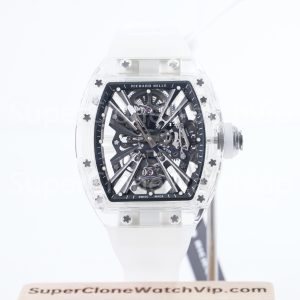
RM 12-01 Transparent-Look Presentation
Use side, rear and rotating video views to verify the exact supplied case, visible layers and moving display. Do not infer case material from a studio image alone.
View Product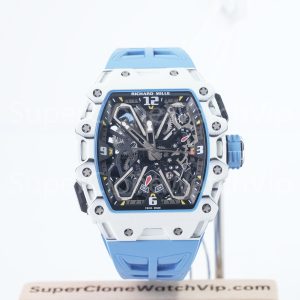
RM 35-03 White-and-Blue Sport Direction
Check bright-surface edge quality, hand contrast, strap color balance and video proof for any moving rotor or selector function claimed for the exact version.
View ProductStrap Integration, Buckle and Comfort
On an RM-style watch, the strap is part of the case architecture. A visible gap, uneven insertion depth or a strap that twists at the connection can make the watch look unfinished and can also change how it sits. Request close-ups of both connection points and compare the left and right sides for equal spacing.
Surface appearance should be checked in normal light. An excessively glossy rubber look can dominate the case, while rough trimming around holes and edges can become uncomfortable. Ask whether the chosen strap length suits the wrist measurement and which hole is expected to be used; comfort cannot be judged from color alone.
Buckle Checks That Photos Often Miss
The buckle should close squarely, hold the strap without side-to-side play and keep the case centered when worn. A short video should show opening, closing and a gentle pull after closure. Also request a flat-table photo with the buckle closed. If the strap or buckle forces the case to lean to one side, the fit problem may remain even when the case dimensions are acceptable.
Movement Appearance vs Functional Proof
An open caseback or skeleton dial can make movement appearance a major part of the purchase, but appearance and operation are different claims. Decorative plates, visible wheels and a rotor-like component may match the visual layout without proving that every displayed mechanism is functional. The product description should identify what the exact version is intended to do, and the QC video should demonstrate those functions one by one.
Do not approve a complicated model because the movement “looks close” in one still image. Ask for normal running, crown winding or setting, date adjustment when present, pusher operation and any special moving display specifically advertised for that watch. If a visible element is decorative, it is better to know before approval than to assume it operates.
What a Factory or Version Label Can—and Cannot—Prove
A factory label may help identify the supplied version, but it does not replace inspection. Request the current version name, then compare it with the actual prepared watch. The relevant proof is whether the case profile, dial layout, strap integration and promised functions match the listing and your approval criteria.
For broader version-selection principles without turning this article into a general purchase manual, see the super clone watch buying guide.
Video QC for Moving Parts and Complications
Still photos are sufficient for scratches, alignment and printed details. They are not sufficient for a chronograph, date change, visible rotor, selector, tourbillon-style display, clasp action or crown operation. Any function that changes position, starts, stops, resets, rotates or locks should be shown in one continuous clip whenever that function is part of the product claim.
The clip should begin with the full watch and then move closer. This makes it harder to confuse a generic demonstration with the prepared watch. Ask the seller to show the dial, caseback and identifying color configuration in the same sequence before operating the function.
RM-Specific Video Request
- Rotate the closed watch from front to both sides and the rear to show layer thickness and strap projection.
- Set the time through the crown and show that the hands move correctly without obvious interference.
- Operate every advertised pusher or selector once, then return it to its starting position.
- Show the date change if the exact model includes a date display.
- Hold the watch under moving light so dial depth, hand contrast and any visible moving display can be judged together.
- Open and close the buckle, then show the strap lying naturally without being forced into shape.
The site’s QC process explains the general pre-shipping review, while the video proof page covers what moving footage can add beyond photos.
Who Can Wear the Size—and Who Should Reconsider
A larger case does not automatically wear larger. Curvature, thickness distribution and strap direction can reduce or increase the effective footprint. The right buyer is not simply someone with a large wrist; it is someone whose wrist shape accepts the case and whose daily routine suits the height, visibility and strap feel.
The Size Is More Likely to Work When
- the case curves with the wrist rather than sitting on two high contact points;
- the first strap section bends down without creating side gaps;
- the buckle centers the watch and does not twist the strap;
- the wearer is comfortable with a highly visible, technical dial during normal daily use.
Reconsider or Choose a Slimmer Family When
- the strap exits straight and extends beyond the top width of the wrist;
- the watch must fit under a tight cuff or stay comfortable during long desk sessions;
- the hands disappear into the skeleton layout in ordinary lighting;
- the buyer wants simple, low-maintenance daily timekeeping rather than a statement piece with several functions to verify.
If the RM architecture remains too bold after these checks, compare a broader range of replica watches or clone watches with simpler case geometry. That is a separate style decision, not a reason to force an oversized RM-shaped model onto the wrong wrist.
Related RM and QC Resources
Richard Mille Replica Watch Selection FAQ
Why do RM-style watches need side-profile photos?
The side view reveals case height, separation between bezel, middle case and caseback, crown alignment and the angle at which the strap leaves the case. A front photo can hide a blocky profile or uneven layer gaps.
How can skeleton dial depth be judged remotely?
Request angled photos and a slow tilt video under ordinary light. Look for changing overlap, shadows and focus between the hands, upper structures and lower dial area. One perfectly flat front image cannot prove depth.
Which moving functions require video?
Request video for chronograph start-stop-reset, date change, crown winding and setting, visible rotor or selector movement, tourbillon-style displays, clasp operation and any other pusher-linked indicator claimed for the exact watch.
Does a larger case always wear larger?
No. A broad curved case with an early strap bend may hug the wrist better than a smaller but flatter case. Side height, wrist-top width and strap projection are more useful than one diameter figure.
What strap and buckle issues should be checked?
Check equal insertion at both case connections, natural downward curve, clean edges and holes, suitable length, a buckle that closes squarely and a closed strap that keeps the case centered instead of twisting it sideways.
Approve Only After Three RM-Specific Gates
Finish the Richard Mille replica watches buying guide with three pass-or-stop decisions. Wrist fit: the case and first strap bend must sit within the usable top width of the wrist. Legibility: the hands must remain readable against the open dial in normal light and crowded positions. Video evidence: every advertised moving function must be demonstrated on the prepared watch.
If one gate fails, change the family, strap configuration or exact version before shipment approval. If all three pass, send the product link, wrist measurement and requested video sequence through the official contact page so the QC request matches the watch you actually selected.
Request RM-Specific QC Evidence