A function-led comparison of two Rolex travel-watch designs, focused on second-time-zone reading, annual-calendar learning, adjustment habits, wrist presence and the exact video checks needed before approval.
Do you need an annual calendar that keeps the month and date organized, or do you mainly want a second time zone you can read and reset quickly after landing? The Sky-Dweller vs GMT-Master II choice starts there. The original Sky-Dweller combines a reference-time disc, month indication and bezel-controlled setting system, but it asks more from the wearer and requires more detailed function verification. The GMT-Master II keeps the travel task more direct: local time on the central hands and reference time through a dedicated 24-hour hand and bezel.
Choose the Sky-Dweller direction when the calendar display and layered mechanical interface are functions you genuinely want to learn and use. Choose the GMT-Master II direction when fast reading and straightforward time-zone changes matter more than calendar complexity. A larger number of indications does not automatically make a watch more useful.
This distinction is especially important when comparing replica versions. The genuine model explains the intended display, but the exact operation of a specific replica must be confirmed from its product information and a demonstration of the actual watch. Buyers browsing broader replica watches and clone watches should still evaluate this comparison by function rather than model recognition. A product name or front photo alone does not prove that every original function has been reproduced.
Complexity or Immediate Readability?
The fastest way to separate these watches is to ask what should happen in the first five seconds after looking at the dial. The GMT-Master II presents conventional local time and a visually distinct 24-hour hand. The Sky-Dweller asks the wearer to recognize the central local time, the off-centre reference-time disc, the date and the active month window.
That extra information can be valuable, but only when it is understood and used. The matrix below treats complexity as a practical cost rather than an automatic advantage.
| Decision Dimension | Sky-Dweller | GMT-Master II | Action Before Choosing |
|---|---|---|---|
| Function learning cost | Higher. The wearer must understand local time, the 24-hour reference disc, month windows, date and the function-selection sequence. | Lower. The main reading task is separating the central local time from the arrow-tipped 24-hour hand. | Ask which displays you could explain without referring to instructions. |
| Adjustment frequency | Potentially fewer calendar corrections on the genuine design, but more steps are involved after the watch stops or needs a full reset. | Usually centred on changing the local hour when arriving in another time zone. | Consider how often you cross time zones and how often the watch may stop between uses. |
| Reading speed | Slower at first because information is distributed across several display areas. | Faster for most new users because the GMT hand and bezel form one direct travel display. | View both dials at normal wrist distance, not only in enlarged product photos. |
| Travel value | Strong when reference time, local time, date and month are all useful during longer or repeated business travel. | Strong when the main task is checking home time and changing local time quickly. | List the functions you would use during an actual trip, not the functions that only look impressive. |
| Nominal size and thickness feel | The original design uses a 42mm case and normally creates a taller, denser visual profile. | The original design uses a 40mm case and generally presents a more compact sports-watch profile. | Check the exact product’s side view, lug reach and bracelet fit rather than diameter alone. |
| Wrist presence | Higher because the case, fluted bezel and layered dial all attract attention. | More concentrated around the coloured bezel and GMT hand. | Smaller wrists should compare angled wrist views and case-side photos before deciding. |
| Visual and formal character | More technical and dress-oriented, with a brighter fluted-bezel profile. | More direct and sports-oriented, with the 24-hour bezel defining the watch. | Treat formality as a secondary filter after deciding which function system is useful. |
| Bracelet or strap | The exact bracelet or strap changes the watch’s weight, flexibility and overall formality. | Oyster and Jubilee-style configurations change the visual balance without changing the core GMT reading method. | Confirm the exact configuration shown on the selected product page and QC media. |
| Function-specific QC burden | Higher. Month indication, reference disc, date, local time and bezel-selection behaviour may all require demonstration. | More focused. The key checks are the 24-hour hand, local-hour setting, date behaviour and bezel alignment. | Do not approve a complex watch based only on static front and side photos. |
| Best suited to | A wearer who enjoys interacting with complications and is willing to learn the display. | A traveller who values immediate reading, simpler adjustment and lower sizing risk. | Choose the behaviour you will repeat, not the specification list you will rarely use. |
Practical rule: Sky-Dweller complexity is worthwhile only when the month display, reference-time disc and setting interaction will be used. If the real requirement is simply to show home time and change local time after landing, the GMT-Master II completes that task with fewer visual and operational layers.
How Each Watch Handles a Second Time Zone
Sky-Dweller: reference time on a rotating 24-hour disc
On the original Sky-Dweller design, the normal central hands show local time. A rotating off-centre 24-hour disc shows reference time, with a fixed triangle pointing to the relevant hour. This keeps home time visible without adding a conventional arrow-shaped GMT hand.
The display becomes easier after the wearer learns where to look, but it is not as immediately familiar as a standard sports-watch dial. The reference disc also occupies space in the centre of the dial, contributing to the Sky-Dweller’s higher information density.
GMT-Master II: reference time through a dedicated 24-hour hand
The original GMT-Master II uses the central hour and minute hands for local time. A separate arrow-tipped hand circles the dial once every 24 hours and is read against the graduated bezel. With the bezel in its neutral position, that hand normally represents home or reference time.
This arrangement is faster to understand because each display has a visually separate job. The central hour hand answers “what time is it here?” while the 24-hour hand answers “what time is it at home?” Rotating the bezel can also change the offset being read, although occasional travellers may never need that additional calculation.
Two-time-zone demonstration
Ask for home or reference time to be set to 08:00 and local time to 14:00. The video should clearly identify which display shows each time and keep both visible in one continuous clip.
Adjustment demonstration
If independent local-hour adjustment is claimed, ask to see the local hour move while the reference-time display remains unchanged. Do not infer this behaviour from the model name.
For the original design references, Rolex explains the Sky-Dweller’s two-zone disc and calendar layout on its official Sky-Dweller page, while the official GMT-Master II page shows the dedicated 24-hour hand and graduated bezel. Replica operation still needs separate confirmation.
Annual Calendar and Month Display Learning Curve
The annual calendar is the feature that most clearly separates the Sky-Dweller from the GMT-Master II. On the genuine Sky-Dweller, the current month is shown by a coloured marker in one of twelve small windows positioned around the hour markers. January corresponds to the first hour marker, February to the second and so on through December at twelve o’clock.
The genuine annual-calendar system distinguishes between 30-day and 31-day months and normally requires one manual correction when February changes to March. That sounds convenient, but the wearer must first learn how the month is displayed, how the date relates to local time and how the relevant setting mode is selected.
A replica Sky-Dweller may reproduce the visible calendar layout without reproducing every part of the genuine calendar mechanism. Some versions may have simplified operation, linked displays or decorative indications. The exact product and version therefore matter more here than on a visually simpler watch.
What a useful calendar video should prove
- The month indicator can be identified clearly at normal viewing distance.
- The seller can set a known month and explain which window represents it.
- The date can be adjusted without ambiguous hand movement or editing between clips.
- The reference-time display, local time and calendar do not interfere unexpectedly.
- The demonstrated operation matches the exact version being offered, not a different sample watch.
One short movement of a month marker does not by itself prove a complete annual calendar. A pre-shipping video is mainly useful for confirming the available controls, the relationship between displays and whether the actual watch behaves as described. Any claim about automatic 30-day and 31-day month handling should be confirmed specifically rather than assumed.
The GMT-Master II avoids this learning curve because its calendar requirement is limited to the date display. That makes it easier after the watch has stopped, easier for occasional rotation and less demanding when the owner does not enjoy resetting multiple indications.
Bezel Interaction and Daily Adjustment
Both watches have rotating bezels, but the bezels perform different jobs. Treating them as interchangeable styling details misses one of the most important functional differences.
Sky-Dweller bezel: select the setting function
On the genuine design, the Ring Command system connects the rotatable bezel, crown and movement. Different bezel positions select the reference time, local time or calendar setting.
The learning task is remembering which position controls which function and returning the bezel to its neutral position after adjustment.
GMT-Master II bezel: change the time-zone offset
The 24-hour bezel is a reading and calculation tool. With the triangle at twelve, the GMT hand normally shows reference time. Moving the bezel changes the offset read against that hand.
The crown handles local-hour adjustment on the genuine design, while the bezel remains available for an alternative time-zone reading.
For someone who crosses time zones frequently, the GMT-Master II method is usually faster: adjust the local hour, leave the reference hand in place and continue reading. The Sky-Dweller can also support local-time changes, but its advantage lies in combining that task with a calendar and a more elaborate selection interface.
A useful function video should not only show the bezel turning. For a Sky-Dweller-style model, it should show whether each bezel position actually selects a different adjustment. For a GMT-Master II-style model, it should show positive bezel positioning, correct alignment with the 24-hour scale and a return to the neutral position.
Adjustment-frequency test: if you expect to change local time several times each month, favour the system you can operate without instructions. If the watch will be adjusted only occasionally and the calendar interaction is part of the appeal, the Sky-Dweller’s extra steps may be acceptable.
Case Size, Dial Density and Wrist Presence
The genuine Sky-Dweller is built around a 42mm case, while the genuine GMT-Master II uses a 40mm case. The two-millimetre difference does not tell the whole story. The Sky-Dweller also carries a fluted bezel, an off-centre 24-hour disc and twelve month-indication positions, so the whole watch can appear larger and busier than the diameter alone suggests.
The GMT-Master II concentrates more of its visual identity around the bezel. Its dial retains the familiar large hour markers, central hands, date and one additional 24-hour hand. This usually makes the information hierarchy easier to recognize from wrist distance.
For a smaller wrist, the GMT-Master II is generally the lower-risk direction, but wrist shape, lug reach, bracelet fit and exact replica case construction still matter. Do not use a universal wrist-size cutoff. Review the actual case-side profile and an angled view showing how far the lugs extend.
The site’s watch size guide provides additional context on diameter, thickness, lug-to-lug distance and bracelet fit. For this comparison, the practical question is whether the larger, denser Sky-Dweller display remains readable and comfortable enough to justify its extra functions.
Exact models to inspect after choosing the function system
These product pages remain relevant to the comparison. Use them to inspect dial density, month-window visibility, bezel alignment and the exact bracelet shown. Product images identify the configuration; they do not replace pre-shipping media of the actual watch.

Sky-Dweller White Dial Oyster 42mm
The lighter dial can make the layered display easier to separate visually. Check the month windows, off-centre disc and date alignment in close-up media.

Sky-Dweller Blue Dial Oyster 42mm
The darker dial creates stronger visual depth. Confirm that the month marker and reference-time disc remain readable under normal lighting.
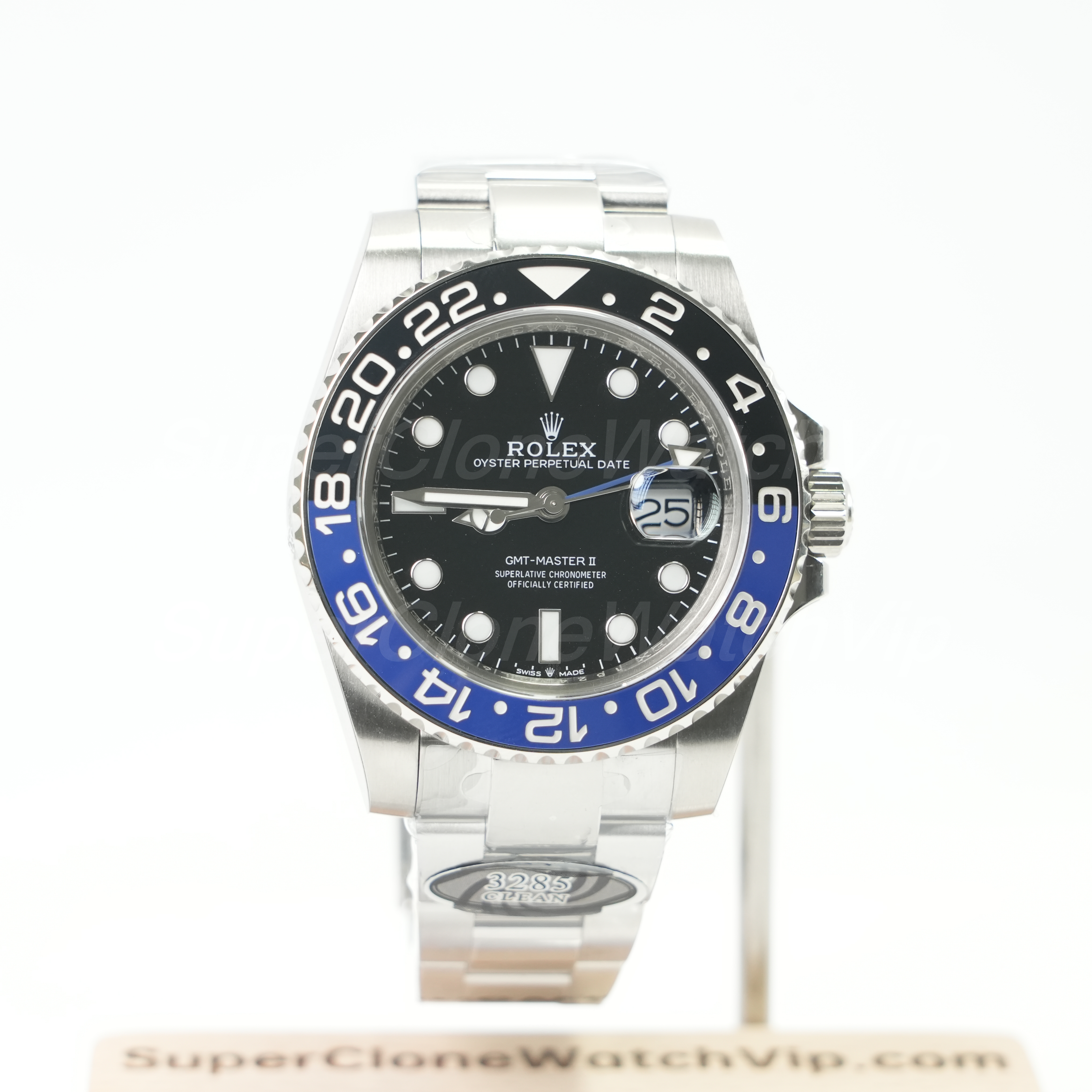
GMT-Master II Batman Oyster 40mm
Use the product page to inspect the black-blue bezel transition, 24-hour scale, GMT hand position and Oyster bracelet fit.

GMT-Master II Pepsi Jubilee 40mm
Inspect the red-blue transition, bezel numerals, arrow-tipped GMT hand, date window and Jubilee link alignment.
Frequent Travel, Business Trips and Occasional Use
Travel frequency changes the answer more than model popularity. A complication has value only when its adjustment method matches the way the owner moves between time zones.
Frequent time-zone changes
GMT-Master II is usually the more efficient choice. Its direct relationship between the local hour, 24-hour hand and bezel reduces the amount of information that must be reset and rechecked after arrival.
Repeated business trips
Sky-Dweller becomes more relevant when the wearer wants home time, local time, date and month available together and is prepared to learn the setting sequence.
Occasional travel
GMT-Master II normally offers enough travel function with less reset effort. Choose Sky-Dweller only when the calendar and interaction remain desirable even during months without travel.
Frequent traveller who wants speed
Choose the GMT-Master II when the priority is changing local time shortly after landing and checking home time without decoding a dense dial. The function remains useful on short trips, connecting flights and repeated journeys through different offsets.
Business traveller who values calendar context
Choose the Sky-Dweller when the month and date are part of the information you expect to consult, not merely decorative elements. It is most convincing when the owner will keep it running regularly and become familiar with the setting positions.
Occasional traveller or rotating-watch owner
A watch that sits unused may stop and require resetting. In that situation, Sky-Dweller complexity can become maintenance rather than convenience. GMT-Master II is usually easier to return to service when only the date, local time and reference time need attention.
The exception is the owner who actively enjoys setting and reading mechanical complications. For that person, the Sky-Dweller’s learning process is part of the value rather than an obstacle.
Function-Specific QC and Demonstration Video
Static QC photos remain useful for checking printing, alignment, case finishing and bracelet fit. They cannot confirm how a calendar changes, whether a reference-time display remains independent or whether a bezel position selects the claimed function.
Review the site’s QC process for the normal exterior inspection, then ask whether video proof before shipping is available for the selected order. Availability should be confirmed before ordering when a full function demonstration is essential.
Sky-Dweller function sequence
- Show the exact watch and product configuration in one uninterrupted view.
- Identify local time and the reference time shown on the 24-hour disc.
- Move the local hour and show whether the reference display remains stable.
- Demonstrate each available bezel-selection position.
- Set a known month and show the corresponding month window.
- Advance or adjust the date and explain its relationship to local time.
- Return the bezel and crown to their normal closed positions.
- Finish with dial, case-side, bracelet and clasp views.
GMT-Master II function sequence
- Show the 24-hour bezel aligned at its neutral twelve-o’clock position.
- Identify the local hour and reference time displayed by the GMT hand.
- Demonstrate local-hour adjustment if that function is claimed.
- Show whether the date follows the local hour correctly.
- Rotate the bezel through several positions and return it to neutral.
- Check the bezel insert, numerals and colour transition at close range.
- Confirm GMT-hand alignment at a known whole hour.
- Finish with end links, clasp, crown and case-side views.
Exterior details that still need photographs
Dial alignment
Check printing, hour markers, hand clearance, month windows and visual centring.
Bezel condition
Check fluted-bezel consistency or GMT scale alignment and insert transitions.
Date and lens
Check date centring, visible magnification, window position and cleanliness.
Case and bracelet
Check the side profile, lugs, crown area, end links, clasp and finishing transitions.
Do not ask only, “Does everything work?”
Name the exact display or adjustment you need to see. A specific request such as “show the month indicator changing and then change the local hour without moving the reference-time display” produces a more useful result than a general function claim.
Sky-Dweller vs GMT-Master II Function FAQ
Is Sky-Dweller difficult to read at first?
It normally requires more familiarization than the GMT-Master II. Local time uses the central hands, reference time uses an off-centre 24-hour disc, and the month appears in one of twelve small windows. Once those positions are learned, reading becomes faster, but the dial still contains more information.
Which watch is easier to adjust when traveling?
GMT-Master II is generally easier for frequent travel because its core task is changing local time while keeping reference time visible on the 24-hour hand. Sky-Dweller can provide the same two-time-zone purpose plus calendar information, but its full setting system involves more display and selector positions.
Does the annual calendar need a full function video?
Yes, when calendar operation is a reason for choosing the watch. Static photos can show the month windows but cannot prove how the month, date, reference time and bezel-selection system interact. Ask for the exact watch to demonstrate the available functions in one continuous video.
Which model suits a smaller wrist better?
GMT-Master II is usually the lower-risk choice because the original design uses a 40mm case and a less crowded dial, compared with the Sky-Dweller’s 42mm case and stronger visual density. The exact replica’s lug reach, case side and bracelet fit should still be checked.
Is GMT-Master II enough for most travelers?
For travellers who mainly need local time and one home or reference time, it is usually enough. Sky-Dweller adds value when the wearer also wants month and date information integrated into the travel display and is willing to manage the additional setting and verification requirements.
Choose the Complication You Will Actually Use
Do not use complication count as a quality ranking. Use function frequency and adjustment willingness instead.
1. Do you mainly need a second time zone that is fast to read?
Start with GMT-Master II.
2. Will you actively read the month indication and keep the calendar set?
Sky-Dweller becomes more useful when the answer is yes.
3. Will the watch stop frequently because it is part of a larger rotation?
GMT-Master II usually requires less relearning and less reset effort.
4. Are you comfortable learning several display and bezel positions?
Choose Sky-Dweller only when that interaction is part of the attraction.
5. Can the exact version demonstrate every function being claimed?
Do not approve the more complex option until the answer is shown in video rather than stated in a description.
The GMT-Master II is the stronger answer when travel value means quick local-time changes and immediate reference-time reading. The Sky-Dweller is the stronger answer when the calendar, month indication and multi-stage interface will be used often enough to justify the learning curve.
After choosing the function system, open the exact model page, confirm the listed configuration and request the corresponding demonstration sequence. That action is more reliable than assuming the more complicated watch is automatically the more suitable one.