You are leaving on Monday morning for a one-week business trip and taking only one watch. The practical Submariner vs GMT-Master II question is whether you will actually read a second time zone during that week, or whether a simpler dive-watch layout will serve you better from the airport to Friday meetings and the weekend after you return.
Choose the GMT-Master II when another time zone will be checked repeatedly and its additional hand and 24-hour bezel support a real routine. Choose the Submariner when the watch needs to remain clear, neutral, and easy to repeat with different clothing. The rest of this guide tests that decision across seven days rather than reducing it to a generic list of specifications.
Monday to Sunday: How Each Watch Fits Real Life
A watch that looks exciting in one product photo may feel demanding after five consecutive days. The Submariner usually asks less from the wardrobe because its dive-watch language is familiar and visually contained. A black bezel, prominent hour markers, and an Oyster-style bracelet create a direct sports-watch profile that can move from commute to meeting without requiring the rest of the outfit to match it.
The GMT-Master II earns its place differently. Its extra 24-hour hand, numbered bezel, and color-separated insert add information and identity. That can be useful and enjoyable on a travel week, especially when home time remains relevant. During a week with no time-zone change, the same details function mainly as visual character rather than essential information.
Across the wider range of replica watches, these two models solve different weekly needs: the Submariner keeps the display restrained, while the GMT-Master II adds a second-time-zone reading system and a more visually active bezel.
Use the table below as a reference-level comparison, not as a promise that every listed product has identical measurements or construction. Exact dimensions and specifications depend on the reference shown on the product page, so the final size check must use that listing and side-view QC photos.
| Real-life checkpoint | Submariner | GMT-Master II | What to verify before choosing |
|---|---|---|---|
| Nominal size | Reference-dependent; linked 116610LN direction is listed as 40 mm | Linked 126710BLNR direction is listed as 40 mm | Confirm the exact reference, then judge lug span and bracelet fit from straight wrist photos. |
| Thickness feel | Can feel more tool-like because of the dive bezel, crown-guard profile, and clasp structure | May look visually fuller because more bezel text and an extra hand occupy the same wrist area | Ask for a true side view and a wrist shot; do not infer height from the front image. |
| Useful function | Elapsed-time reading through a dive-style 60-minute bezel | Second-time-zone reading through a dedicated 24-hour hand and bezel scale | Choose the function you will read during an ordinary week, not the one with the more interesting description. |
| Visual language | Cleaner, more uniform, and strongly associated with a dive-watch silhouette | More technical and often more colorful because of the 24-hour scale and two-tone insert | View the watch beside the colors you wear most: black, navy, grey, denim, earth tones, or brighter layers. |
| Bracelet direction | Primarily an Oyster-bracelet identity with a firm sports-watch look | Oyster for a sportier profile or Jubilee for more articulation and reflected light | Confirm the exact bracelet and clasp shown on the selected product, not only the bezel color. |
| Repeated daily wear | Usually easier to repeat with changing work and casual outfits | Best when the second time zone or stronger bezel identity remains relevant through the week | Count how many days involve travel, remote teams, overseas family, or a need for a visual accent. |
| Formal clothing | Black versions generally create less color conflict under a jacket or cuff | A darker bezel can work well; Jubilee adds polish but also more shine | Test the watch against your actual shirt cuff and jacket sleeve, not a bare-wrist image alone. |
| Model-specific QC pressure | Pearl centering, minute-bezel alignment, dial symmetry, date/cyclops where fitted, and clasp finishing | Color transition, 24-hour numerals, GMT hand, date/cyclops, hand clearance, and bracelet finishing | Request front, angled, side, date, clasp, and bracelet photos of the actual unit. |
| Best-matched wearer | Wants one straightforward sports watch that does not dominate the week | Uses another time zone or deliberately wants the watch to carry more visual information | Base the decision on the three situations you repeat most, then choose the reference. |

A black Submariner direction keeps the bezel and dial visually unified across repeated daily wear.
One Time Zone or Two: The Function That Changes the Choice
The GMT function is valuable only when it is tied to a person, place, or schedule. A traveler can leave the 24-hour hand on home time while the conventional hour hand follows local time. The same arrangement can help someone who works with an overseas office, follows a market in another region, or regularly calls family abroad. In those routines, the GMT-Master II is not merely the more colorful option; it removes a small calculation several times a day.
If you rarely travel and do not track another location, the GMT display can still be enjoyed as design, but it should not be treated as a necessary purchase reason. Ask yourself a precise question: during the last seven days, how many times did you need to know another time zone without opening a phone? Zero or one use points toward choosing by appearance. Several uses each day give the GMT function real weight.
The Submariner’s bezel serves a different habit. Its minute scale is suited to timing an interval, such as a commute segment, parking period, break, cooking task, or exercise block. It does not provide another time zone, but the reading is direct: align the marker with the minute hand and monitor elapsed minutes.
A practical seven-day check
Write down every time you check another city’s time for one week. If the list remains almost empty, compare the watches primarily through legibility, bezel appearance, bracelet feel, and clothing. If the list becomes part of your daily workflow, start with the GMT-Master II collection and confirm that the selected version supports the function described on its product page.
Bezel Language: Dive Timing vs Travel Reading
The bezels communicate their purpose before either one is operated. On a Submariner, the scale is organized around minutes, with a clear reference point at 12. On a GMT-Master II, the numerals run through a 24-hour cycle and the color division helps separate portions of the day. Rolex describes the original Submariner bezel as a unidirectional 60-minute timing scale and the original GMT-Master II as using a dedicated 24-hour hand with a 24-hour graduated two-colour bezel.
That difference also changes how the watch reads from across a room. A black Submariner bezel tends to merge with a black dial, so the case and hour markers define the silhouette. A blue-black or red-blue GMT insert creates an immediate band of color around the dial. Buyers who like a watch to remain in the background often prefer the first effect; buyers who want the watch to contribute to the outfit often prefer the second.
During QC, do not check only whether the bezel is centered at 12. For the Submariner, inspect the pearl or triangle position, minute markings, engraving fill, and whether the insert sits evenly. For the GMT-Master II, inspect the 24-hour numerals and the transition between bezel colors under neutral lighting. Strong reflections can hide uneven color boundaries or make normal ceramic variation appear more dramatic than it is.
Original design references: Rolex Submariner and Rolex GMT-Master II.
Dial Density and At-a-Glance Legibility
A smaller wrist does not automatically require a smaller nominal diameter. Visual density often matters more. The Submariner’s hour, minute, and seconds display is easier to separate because the dial is not carrying a dedicated GMT hand. A no-date direction is cleaner again, while a date version introduces the window and cyclops familiar to many buyers.
The GMT-Master II adds another hand with an arrow tip and asks the eye to distinguish conventional time from the 24-hour indication. This is useful when the function is used, but it makes the center of the dial busier. On a smaller wrist, the color of the GMT hand and bezel may increase apparent size even when the case dimensions remain close to the Submariner being compared.
Check clarity in three views
Ask for a straight front image, a wrist image at normal distance, and a low-light image if available. Macro shots reveal printing, but normal-distance photos reveal whether the hands and markers separate quickly.
Use a five-second test
Open each front photo at the same size and glance for five seconds. Note which watch gives the local time faster and whether the GMT hand is immediately distinguishable from the minute hand.
Wrist Presence, Bracelet and Long-Day Comfort
Comfort over ten hours depends on more than case diameter. Bracelet articulation, link edges, clasp length, adjustment range, total balance, and how tightly the watch is sized can change the experience. A front-on product image cannot confirm any of these points.
The Submariner’s Oyster-bracelet identity creates a broad, continuous sports-watch line from case to clasp. Buyers who prefer a firm, stable feel often appreciate that structure. The GMT-Master II can also use an Oyster-style bracelet, while a Jubilee-style option introduces smaller articulated links and more polished surfaces. Jubilee may conform differently around the wrist and can feel more visually refined, but its additional reflections make the watch more noticeable under office or evening lighting.
Before approval, request one photo with the clasp closed, one with it open, and one showing the bracelet from the side. Look for consistent brushing or polishing, clean link transitions, and a clasp that matches the selected product. Ask the seller to confirm available sizing or removable links rather than assuming every wrist can be fitted in the same way.
For a long flight
Prioritize bracelet articulation, clasp comfort, and a fit that tolerates minor wrist expansion.
For desk work
Check clasp length against the desk surface and whether polished links create more shine than desired.
For active weekends
Look for stable sizing, secure clasp closure, and a bracelet finish that suits frequent casual wear.

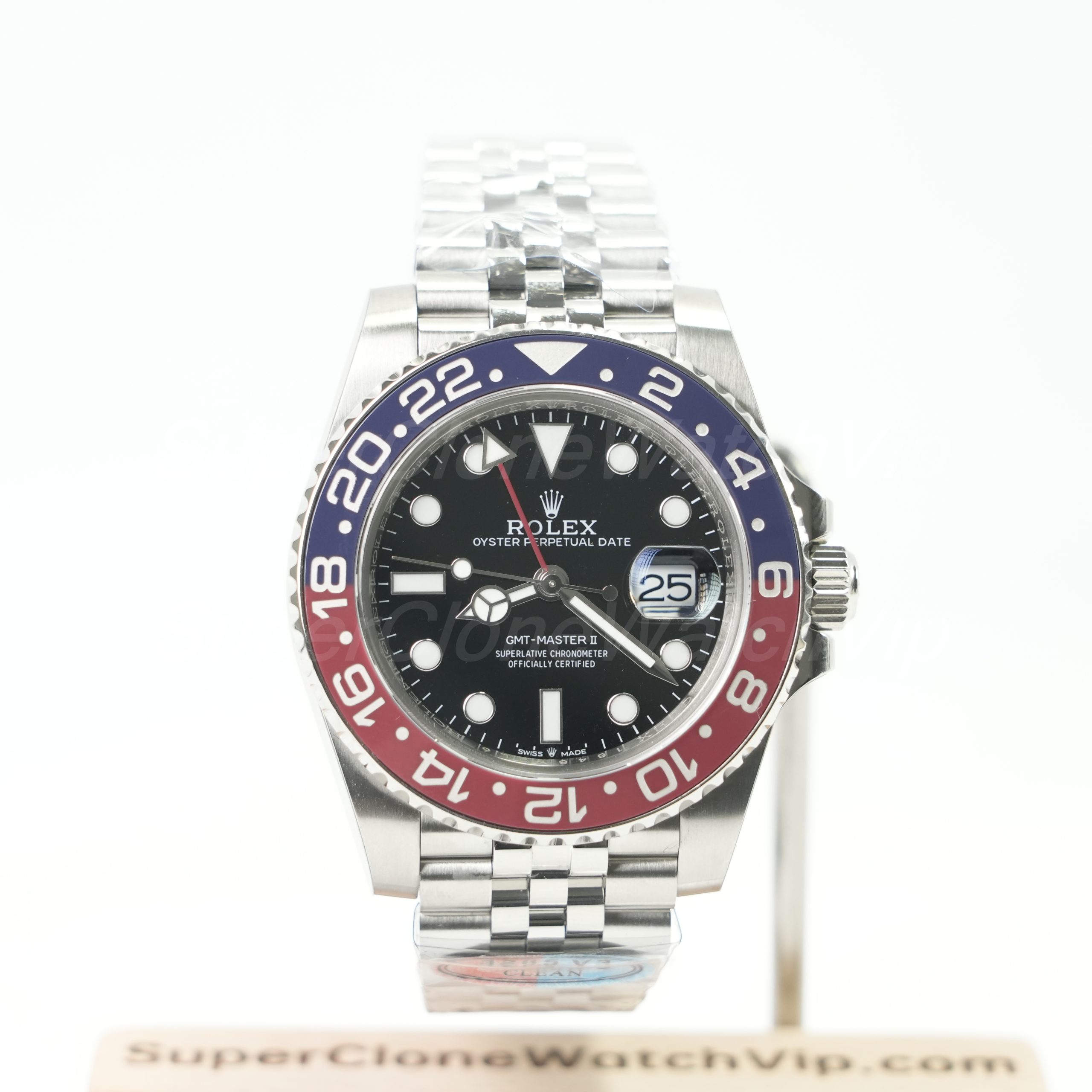
A blue-black GMT-Master II on Jubilee combines a practical second-time-zone display with more color and reflected light.
Travel, Office and Weekend Wardrobe Test
Instead of deciding from isolated watch photos, place each option into three outfits you already wear. Use one work combination, one travel or weekend combination, and one more formal combination. This exposes color conflict and attention level faster than a long feature list.
Office: shirt, knitwear, jacket, or business casual
A black Submariner usually sits quietly beside navy, grey, white, black, and denim. The watch remains visibly sporty, but the bezel does not introduce a new color. A blue-black GMT can also work in this setting, particularly when blue already appears in shirts, jackets, or accessories. A Jubilee bracelet adds polish, although buyers who prefer a low-reflection look may favor Oyster.
Travel: airport, hotel, remote work, and changing time zones
The GMT-Master II has the clearer functional advantage when home time remains on the dial. Its bezel also suits the travel narrative visually. The Submariner remains easier when the trip involves one time zone, mixed clothing, outdoor activity, and no desire to manage an additional display.
Weekend and evening: when the watch can become part of the outfit
This is where a GMT colorway can justify itself even without frequent travel. Blue-black is controlled, while red-blue creates a stronger visual point. The Submariner remains more restrained and can move between casual clothing and a dinner setting without changing the palette.


Model-Specific QC Traps
The two watches share basic inspection needs—dial cleanliness, marker placement, date centering where applicable, cyclops position, case condition, bracelet finishing, and clasp closure—but their most visible failure points are not identical. A useful QC request should name those differences rather than asking whether the watch “looks good.”
As with other clone watches, the final approval should be based on photos of the actual unit rather than product-page images alone. For this comparison, the inspection request must also reflect the different bezel and hand layouts.
Submariner inspection sequence
- Center the front photo and compare the 12 o’clock marker with the bezel triangle or pearl.
- Check minute markers and hour indices for even spacing and obvious tilt.
- On a date version, inspect date centering and cyclops placement at more than one date if available.
- Use a side image to review crown guards, bezel seating, crystal edge, and case profile.
- Inspect brushing direction and clasp finishing under neutral light.
GMT-Master II inspection sequence
- Inspect the bezel’s two-color transition in a straight photo and a second photo under neutral light.
- Check 24-hour numerals for consistent depth, fill, spacing, and alignment with the dial.
- Confirm the GMT arrow is clean, visually distinct, and not obviously contacting another hand.
- Review date centering, cyclops position, and hand alignment through several crown-setting positions if video is available.
- Match Oyster or Jubilee finishing to the exact configuration ordered.
Do not approve from one front image
Ask for the actual watch from the front, both sides, an angled bezel view, clasp open and closed, bracelet close-ups, and a clear date view where applicable. Product photography chooses the model; QC photography checks the individual unit.
Choose Through a Seven-Day Scenario
The scorecard below measures suitability for a task and visual setting, not build quality. A score of 5 means the model’s function or design naturally supports that scenario; a score of 3 means either watch can work and the exact reference matters more. Change any score that does not match your real clothing or routine.
| Day / scenario | Submariner fit | GMT-Master II fit | Reason to adjust the score |
|---|---|---|---|
| Monday — commute | 5/5 | 4/5 | Raise GMT to 5 when the commute begins with calls to another time zone. |
| Tuesday — client meeting | 5/5 | 4/5 | A dark GMT can equal the score; reduce it when bright bezel color distracts from formal clothing. |
| Wednesday — travel | 3/5 | 5/5 | Keep both at 4 when the trip stays in one time zone and the choice is mainly comfort. |
| Thursday — casual workday | 5/5 | 5/5 | Let bracelet preference and bezel color decide this tie. |
| Friday — night setting | 4/5 | 5/5 | Reduce GMT to 4 when you prefer minimal shine or a quieter wrist. |
| Saturday — outdoor activity | 5/5 | 4/5 | Do not assume water use is approved; any exposure depends on testing of the exact unit. |
| Sunday — formal occasion | 4/5 | 4/5 | A black Submariner is quieter; a dark-bezel GMT on Jubilee may feel dressier but more reflective. |
Turn the scores into a decision
- Circle the three scenarios that occur most often in your real month, even if they fall on different days than the table.
- Add only those three scores. Ignore rare situations that make the less-used watch appear more practical.
- When the result is tied, use dial clarity and bracelet comfort as the tiebreakers.
- Open the matching collection page, shortlist one exact reference, and request model-specific QC views before approval.
Submariner vs GMT-Master II FAQ
Is a GMT function useful if I rarely travel?
It can still be useful when you regularly track an overseas office, market, friend, or family member. Without that habit, the GMT hand and 24-hour bezel are primarily design features. Count actual second-time-zone checks for seven days before treating the function as a deciding advantage.
Which model looks less busy on a smaller wrist?
A black Submariner usually looks less busy because it has no dedicated GMT hand and its bezel contains less numerical information. A dark blue-black GMT can still work well, but the colored hand and 24-hour scale create more visual density. Compare equal-size wrist photos instead of relying on diameter alone.
Does the Submariner feel more versatile with formal clothing?
A black Submariner generally creates fewer color conflicts and less reflected light, so it is easier with a shirt cuff or dark jacket. A GMT-Master II with a restrained bezel can also work, and Jubilee may add polish, but the result is more visually active.
What bezel and hand details differ in QC?
For a Submariner, focus on the bezel triangle or pearl, minute-scale alignment, dial symmetry, and date/cyclops where fitted. For a GMT-Master II, add the two-color transition, 24-hour numeral alignment, GMT arrow finish, and clearance between the extra hand and the rest of the hand stack.
Which is easier to choose as a first sports watch?
The Submariner is usually easier because the decision involves less color and fewer display elements. Choose the GMT-Master II first when the second time zone already belongs to your routine or when bezel identity and bracelet choice are more important than visual simplicity.
Use Your Three Most Frequent Days
Return to the seven-day table and keep only the three situations that consume most of your month. A schedule dominated by commuting, meetings, neutral clothing, and one time zone normally leads toward the Submariner. A schedule dominated by travel, overseas coordination, evening settings, or a deliberate color accent normally leads toward the GMT-Master II.
Do not add points for an imagined trip or a formal event that happens once a year. Let repeated use decide the series, let a wrist photo decide visual balance, and let model-specific QC decide the individual watch.