A 36mm smooth-bezel Datejust on Oyster can favor a different prepared piece from a 41mm fluted-bezel model on Jubilee, even when both carry the same factory label. That is why Clean vs VSF Datejust should begin with the complete configuration, not a fixed factory ranking. Lock the size, bezel and bracelet first; then let straight-on photos, angled views and function video decide which actual watch is stronger.
This page stays inside that factory-comparison task. Broader model selection belongs in the Datejust configuration guide, while general research across replica watches should remain on the main site.
Article Navigation
Datejust exposes small differences quickly. Its dial is open, the crystal and date magnifier sit near the visual center, and polished case or bracelet surfaces reflect every change in angle. A broad statement such as “Clean has the sharper look” or “VSF has the better crystal” is therefore incomplete unless it names the size, dial, bezel, bracelet, current version and the prepared watch shown in QC.
The useful comparison is conditional: compare the same Datejust configuration, record the seller’s current version wording, review equivalent photos, and approve only the piece that passes the checks relevant to that configuration. The factory name creates a shortlist; the evidence selects the watch.
Fix the Datejust Configuration Before Comparing
Do not compare a Clean 41mm fluted/Jubilee example with a VSF 36mm smooth/Oyster example and call the result a factory verdict. Size changes dial spacing and case presence; the bezel changes how strongly the watch reflects light; the bracelet changes both the visual texture and the number of fit points that need inspection.
Write the target as one complete line before asking for factory advice: size + dial and markers + bezel + bracelet + listed material or finish + seller-stated movement + current factory version. If any of those fields is still open, use the configuration guide first rather than forcing this page to choose the model for you.
36mm or 41mm
Use the same size on both sides. Check dial spacing, lug shape and bracelet width as a complete proportion rather than judging diameter alone.
Smooth or Fluted
A smooth bezel needs continuous polish and an even case transition. A fluted bezel needs repeated geometry and consistent light movement around the full circle.
Oyster or Jubilee
Oyster concentrates attention on brushing, edge lines and straightness. Jubilee adds link articulation, end-link fit and polished/brushed transitions.
Simple or Complex Dial
Baton dials expose print and alignment. Roman, motif or decorative-marker layouts add more positions that need straight-on inspection.
Boundary rule: this article compares Clean and VSF only after the configuration is fixed. For wrist size, dial-color selection or whether a buyer should choose smooth versus fluted in the first place, return to the Datejust size and style guide.
Dial Printing, Markers and Color Consistency
Start with a level, straight front image. The crown emblem, 12 o’clock marker, minute track, lower text, date aperture and rehaut should read as one centered system. Camera tilt can make a correct dial look wrong, so reject neither factory from an angled glamour shot alone.
Use the dial type to set the inspection method
- Black or dark baton dials: enlarge the photo for dust, lint, weak print edges and marks that disappear in normal catalog images.
- Blue or other sunray dials: request one neutral-light front image and one short angled video. The color should change with light without one side looking permanently muddy or mismatched.
- Silver or light dials: check whether hands and markers remain clearly separated from the background and whether the print keeps enough contrast.
- Roman, Wimbledon, motif or decorative-marker layouts: inspect every marker position, not only 12 and 6. More visual elements create more possible alignment or setting issues.
For Clean, ask whether the actual dial keeps the sharpness and marker placement that motivated the shortlist. For VSF, ask whether the actual dial remains balanced once the crystal and date magnifier are included in the same straight view. Neither direction should pass on reputation when the prepared dial shows uneven markers, unclear printing or inconsistent color.
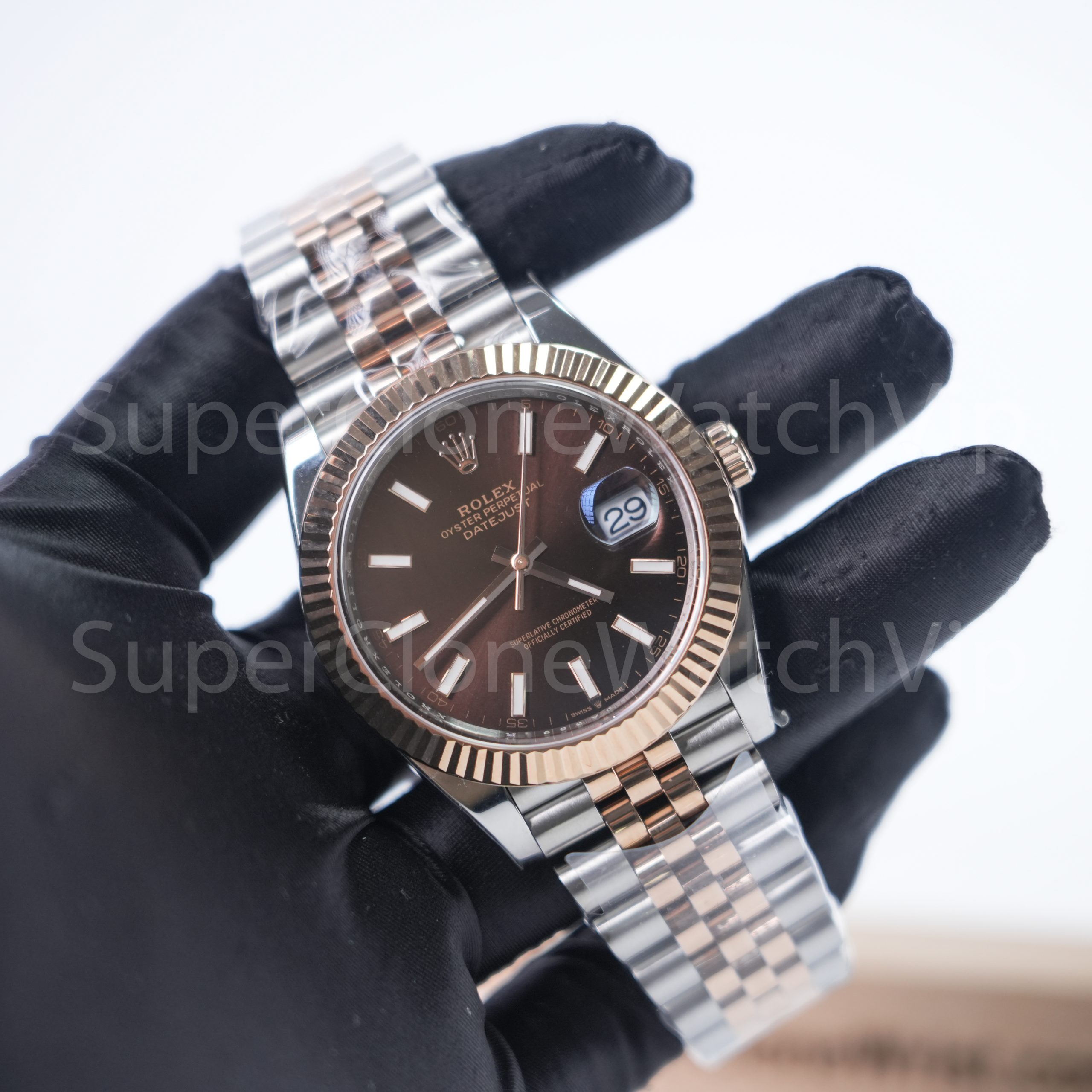
Use angled light after the straight view
This existing image is useful for chocolate dial tone, marker setting, bezel reflection and bracelet flow, but it should supplement rather than replace a centered front photo.
Crystal, Cyclops and Date-Window Alignment
The Cyclops is easy to misjudge because camera position changes apparent magnification and date centering. The decisive image must be taken with the watch level, the camera centered over the dial and the lens axis as close to perpendicular as practical. An angled image can show reflection and crystal profile, but it cannot settle left-right or high-low alignment.
Request this three-part evidence set
- Straight full-dial photo: confirms whether the Cyclops sits over the date aperture and whether the date appears centered in the window.
- Straight close-up from the same axis: checks date-font clarity, window edges and visible distortion without introducing a new camera angle.
- Short side-to-side video: shows crystal reflection and whether clarity changes abnormally as the watch moves through light.
When function video is available, ask to see at least one single-digit and one double-digit date. That does not create a new specification; it simply checks whether different numerals remain reasonably centered and readable. If one photo makes the magnification look strong and another makes it look weak, compare camera distance and angle before treating it as a factory difference.
The official Rolex Datejust reference page can be used for original model terminology and general design context. It should not replace inspection of the actual Clean or VSF piece offered.
Smooth vs Fluted Bezel Considerations
A smooth bezel and a fluted bezel should not share the same QC script. The smooth version is visually simple, so polish quality and the transition into the case become the test. The fluted version contains repeated geometry, so consistency around the full circle matters more than one attractive highlight.
Smooth bezel approval
- Continuous polish without obvious flat or cloudy areas.
- Even gap and transition between crystal, bezel and case.
- No visible dents, waviness or one-sided distortion.
- Similar reflection on left and right angled views.
Fluted bezel approval
- Consistent flute definition around the whole bezel.
- No isolated soft, dark, damaged or differently cut section.
- Even seating around the crystal and case.
- A slow rotation video in neutral light, not only a bright front shot.
This is one area where configuration can change the factory preference. A Clean piece with a convincing dial may still lose the comparison if its fluted bezel looks uneven. A VSF piece with a clear Cyclops may still lose if the smooth bezel or case transition is visibly weaker. Judge the complete front assembly rather than awarding the category in isolation.
Case, Rehaut and Crown Proportion
The 36mm and 41mm cases should be reviewed as different proportion systems. Compare the prepared watches from the same three positions: straight front, crown side and opposite side. This shows whether the lugs, bezel height, crystal profile, crown placement and bracelet end links work together instead of appearing assembled from unrelated parts.
From the front, check whether the rehaut reads evenly around the dial and whether its alignment supports rather than fights the marker layout. From the side, look for balanced case thickness, smooth transitions between polished and brushed areas, and a crown that sits naturally in relation to the case. Do not use one macro view to judge the complete proportion.
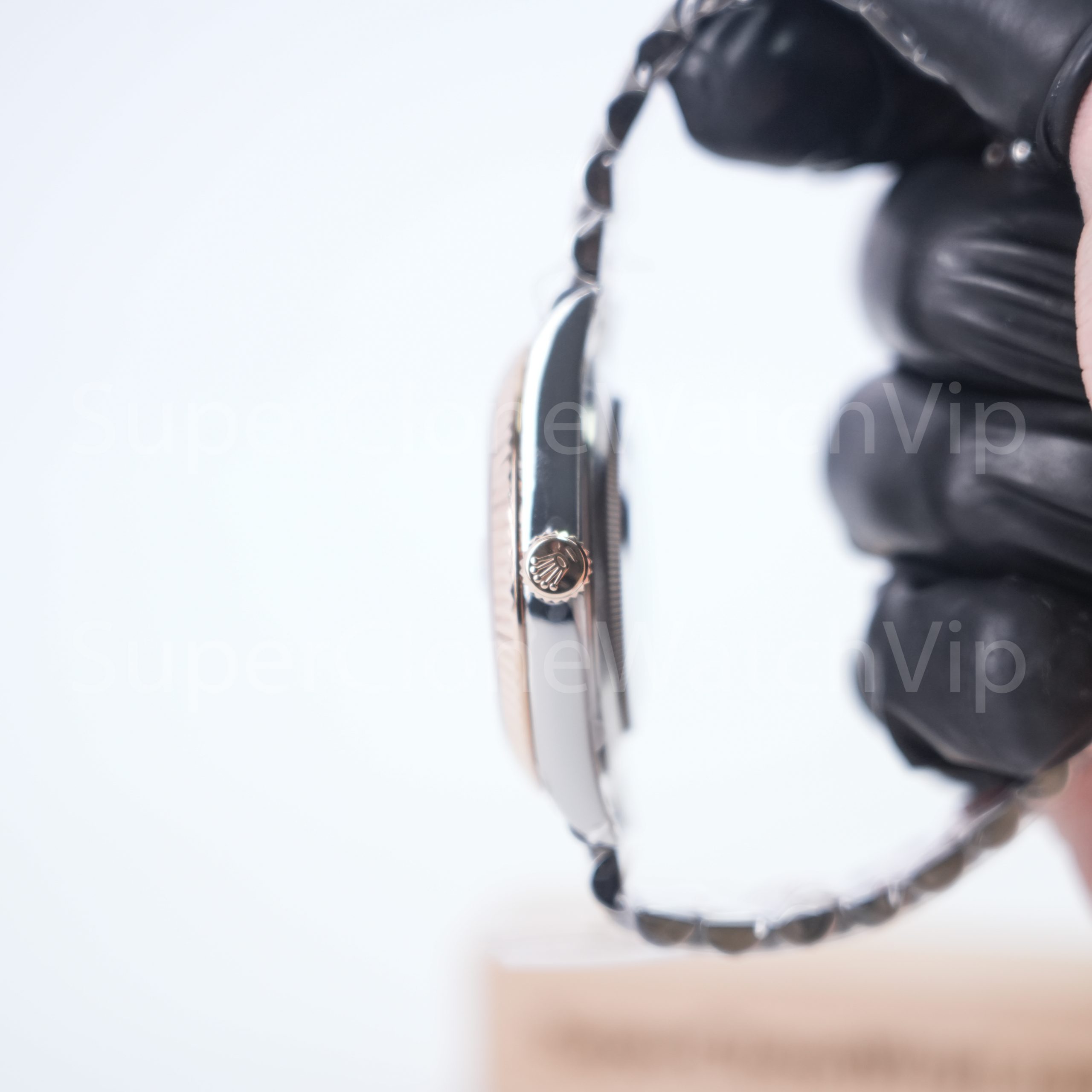
Why the side profile belongs in the comparison
This existing side view can reveal crown position, case thickness, bezel-to-crystal height and bracelet curve. Request the equivalent angle for both factories before deciding that one case is better proportioned.
A direct A/B comparison is most useful when both watches use the same size and the photos are taken at similar distance. A 41mm case can appear thinner or wider merely because one image was shot closer. Ask for a repeat photo before rejecting a watch on a proportion that may be photographic.
Oyster vs Jubilee Bracelet and Clasp
Bracelet inspection must change with link construction. Oyster has fewer visual transitions, so straight brushing, edge finishing, center alignment and clasp fit become obvious. Jubilee has more small links and more movement, so articulation, symmetry, end-link seating and the polished/brushed pattern need both photos and video.
Oyster bracelet checks
- Brushing runs in a consistent direction without visibly darker replacement-looking sections.
- Outer edges look even and free from obvious sharp contact points.
- End links sit evenly against both lugs.
- The clasp closes straight, remains centered and opens without abnormal resistance in the video.
Jubilee bracelet checks
- Lay the bracelet flat to compare left-right link symmetry and end-link gaps.
- Let it hang naturally to show whether the links articulate smoothly rather than bunching at one point.
- Move it through a wrist-shaped curve to reveal pinching, stiff sections or unusual looseness.
- Close the clasp on video and inspect its alignment from the underside and side.
Do not turn bracelet feel into a vague claim such as “VSF wears better” or “Clean finishes better.” Translate the claim into evidence: end-link fit, link movement, surface transitions, clasp action and the way the bracelet follows the case. The prepared bracelet that demonstrates those points is the stronger choice.
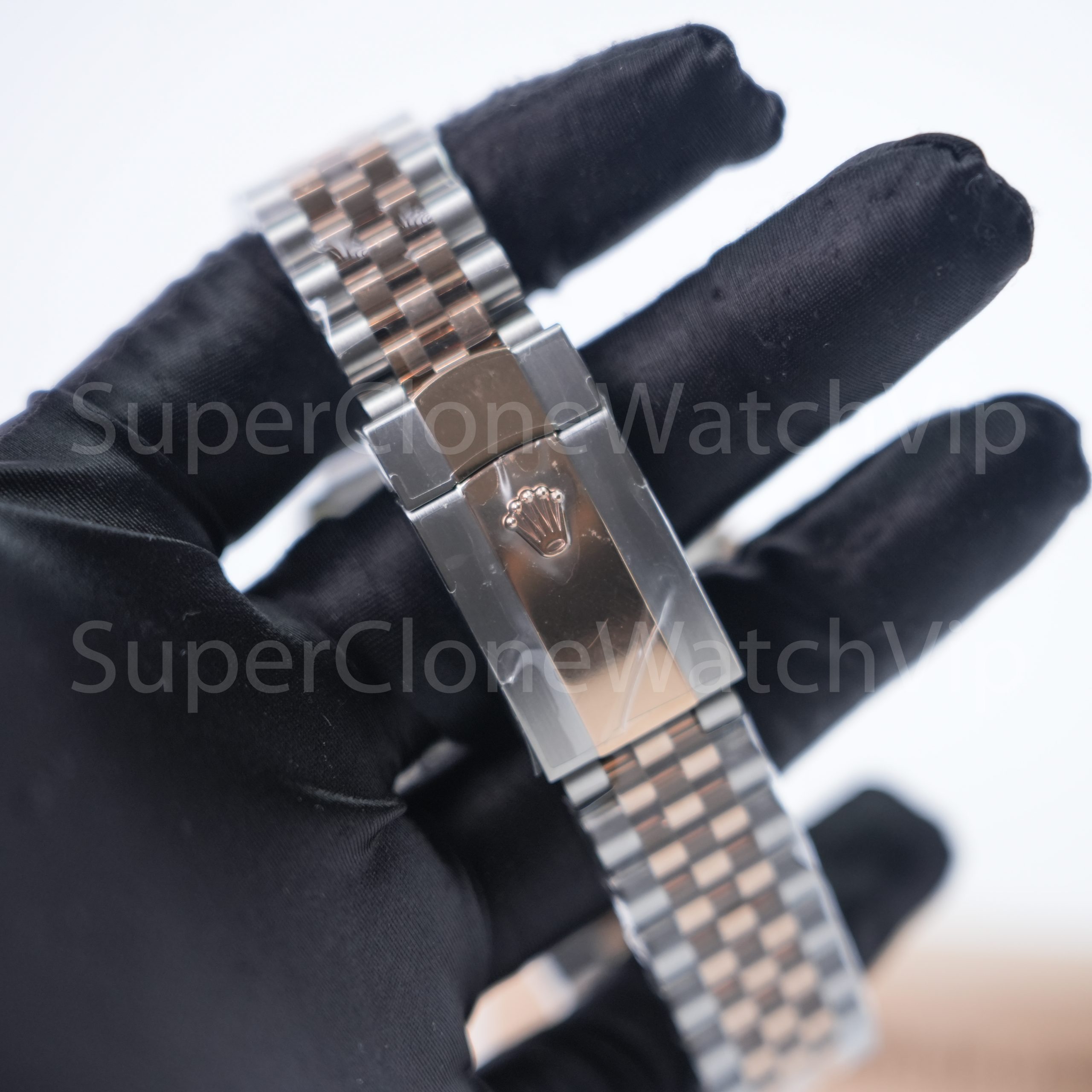
Static clasp view, followed by movement proof
This close view helps inspect alignment, surface transitions and visible condition. Add a short open-close and articulation video before approving a Jubilee configuration.
Date Change, Movement and Functional QC
Do not infer the movement from the factory name. Record the movement description exactly as the seller lists it for that product and version, then compare Clean and VSF only when the quoted configurations are genuinely equivalent. If the descriptions differ, the price comparison is no longer like-for-like.
A short function video should show the crown positions, time setting, date adjustment where applicable, hand movement and the date transition. The goal is not to demand a scripted promise that every date flips at an exact second. The goal is to confirm that the prepared watch can be set normally, the date advances cleanly and the displayed date settles correctly in the window.
Written specification
Factory, current version wording, seller-stated movement, size, dial, bezel and bracelet must match the order record.
Crown and setting
Check winding and setting positions, hand response and whether the crown returns to its normal position without visible difficulty.
Date operation
Watch the date advance, then return to a straight photo to confirm centering after the change.
Like-for-like budget
Compare quotes only when configuration, movement description, QC evidence and included service are the same.
Use the site’s video proof before shipping page for the evidence format. This section should not become a full movement guide or a general ordering tutorial; it exists only to stop a visually good Datejust from being approved without basic date and crown checks.
Clean or VSF by Datejust Configuration
The matrix below does not declare one permanent winner. It shows what each factory candidate must prove on the exact 36mm or 41mm, smooth or fluted, Oyster or Jubilee configuration. “Approve” means the actual QC set passes the condition; “hold” means the evidence is incomplete or the two quotes are not equivalent.
36mm factory-selection matrix
| 36mm setup | What this setup exposes | Approve the Clean candidate when | Approve the VSF candidate when | Decision rule |
| Smooth + Oyster | Compact case proportion, restrained dial, bezel polish, straight bracelet line. | Dial alignment, case edges, smooth-bezel transition and Oyster brushing all remain controlled in neutral light. | Crystal/date presentation, compact case balance and Oyster fit remain controlled in the same views. | No preset winner; choose the cleaner complete proportion. |
| Smooth + Jubilee | Simple bezel against a highly articulated bracelet; end-link fit becomes obvious. | The sharper visual candidate also shows smooth link movement, even end links and a straight clasp. | The crystal/date candidate also shows a clean smooth bezel and Jubilee articulation without bunching. | Hold if only front photos are supplied. |
| Fluted + Oyster | Flute consistency plus the straighter, quieter bracelet surface. | Dial and flute definition stay consistent through a slow rotation, with clean Oyster brushing. | Cyclops/date alignment and case balance remain strong without a weak section in the fluted bezel. | Bezel video can reverse the initial factory preference. |
| Fluted + Jubilee | The most reflective 36mm setup: dial, bezel and bracelet all compete for attention. | Dial placement, fluted geometry, polished/brushed transitions and clasp alignment pass together. | Crystal/date view, compact case proportion, bezel consistency and Jubilee movement pass together. | Use identical lighting and equivalent video before choosing. |
41mm factory-selection matrix
| 41mm setup | What this setup exposes | Approve the Clean candidate when | Approve the VSF candidate when | Decision rule |
| Smooth + Oyster | Larger dial spacing, case width, smooth-bezel polish and long bracelet lines. | The dial remains centered and crisp while the wider case and Oyster bracelet stay visually straight. | The crystal/date view remains clear and the larger case does not look top-heavy or poorly integrated. | Compare same-distance side photos before deciding. |
| Smooth + Jubilee | Large open dial against a highly textured bracelet; clasp and end links are prominent. | Dial sharpness is matched by controlled bezel polish, link symmetry and a centered clasp. | Crystal/date balance is matched by clean end links and smooth bracelet articulation. | Do not let dial preference hide bracelet defects. |
| Fluted + Oyster | Strong bezel presence with a cleaner bracelet; rehaut and case alignment remain visible. | Fluted definition, dial placement and Oyster finishing remain consistent through front and side views. | Cyclops/date, case profile and bezel seating pass without sacrificing bracelet straightness. | The weaker bezel or date view should end the comparison. |
| Fluted + Jubilee | Maximum dial, bezel and bracelet visibility; small inconsistencies are amplified. | Dial, markers, fluted reflections, Jubilee transitions and clasp all pass the same QC set. | Crystal/date clarity, case balance, bezel consistency and bracelet movement all pass the same QC set. | Choose only after direct A/B evidence on the exact dial. |
Budget and buyer-fit rule
The correct budget comparison is the price of the same configuration, seller-stated movement, current version and QC support. A cheaper quote with a different dial, bracelet, movement description or evidence package is not proof that one factory offers better value.
A buyer who wants the least visually demanding decision should compare simpler baton-dial and smooth/Oyster setups. A buyer choosing fluted/Jubilee, two-tone or a complex dial should expect a longer QC review because more reflective and alignment-sensitive areas are visible. For full style selection, use the configuration guide rather than expanding this factory page into another buying guide.
Conditional Conclusion by Complete Setup
For a 36mm smooth/Oyster setup, choose the actual Clean or VSF piece with the cleaner compact proportion, smooth-bezel transition, centered date and straight brushing. For 36mm fluted/Jubilee, the factory preference should remain open until bezel rotation and bracelet articulation are shown.
For a 41mm smooth/Oyster setup, prioritize dial spacing, case width, side profile and the way the longer bracelet line meets the lugs. For 41mm fluted/Jubilee, use the strictest evidence set: straight front, date close-up, both case sides, slow bezel rotation, bracelet movement and clasp action under comparable light.
Mixed combinations follow the same rule. Fluted/Oyster increases bezel sensitivity while keeping bracelet review simpler; smooth/Jubilee reduces bezel geometry but raises the importance of link movement and end-link fit. The winning factory is the one whose prepared watch proves the configuration-specific points—not the one with the louder forum reputation.
The next action is specific: send the exact size, dial, bezel and bracelet; request the current Clean and VSF version wording; compare equivalent quotes; and ask for the same straight, angled and functional QC set. Broader clone watches research should not replace this reference-level evidence.
Request an Equivalent Clean and VSF QC Set
Send one complete Datejust configuration and ask whether both factories are currently available for that exact setup. Confirm the seller-stated movement, version wording and like-for-like price, then request straight dial and Cyclops photos, bezel angles, both case sides, bracelet and clasp views, plus date and crown video before approval.
Related Reading
Clean vs VSF Datejust FAQ
Does the preferred factory change between 36 and 41 mm?
It can, because the two sizes expose proportion differently. On 36mm, compact dial spacing, lug shape and bracelet integration carry more weight. On 41mm, the larger dial, wider case and stronger bezel presence make side profile and front alignment more visible. Compare the same size and configuration before assigning a preference.
Which Cyclops issues need straight-on photos?
Use a level straight photo for left-right placement, high-low placement, date-window centering and apparent symmetry over the aperture. Magnification and clarity should also be checked from the same axis before angled images are used to judge reflection.
Does a fluted bezel require different QC?
Yes. A smooth bezel mainly needs even polish and a clean case transition. A fluted bezel needs consistent geometry around the full circle, so request both angled photos and a slow rotation video to find isolated soft, dark or uneven sections.
How should Jubilee bracelet fit be checked?
Review it flat for symmetry and end-link gaps, hanging for natural articulation, curved for stiff or pinching sections, and closed for clasp alignment. A still image can confirm surfaces; only movement shows how the small links behave together.
When should a buyer return to the Datejust configuration guide?
Return when size, dial, bezel or bracelet is still undecided. This page is for comparing Clean and VSF on an already fixed setup; it should not choose between 36 and 41mm or build the entire Datejust configuration from the beginning.